Impact
 Initiatives
 Dashboard
 Alliances

 Impact
 Initiatives
 Dashboard
 Alliances
Annual Report 2026
Building together the future of innovation for the agrifood systems of Latin America and the Caribbean.
Who we are
About FONTAGRO
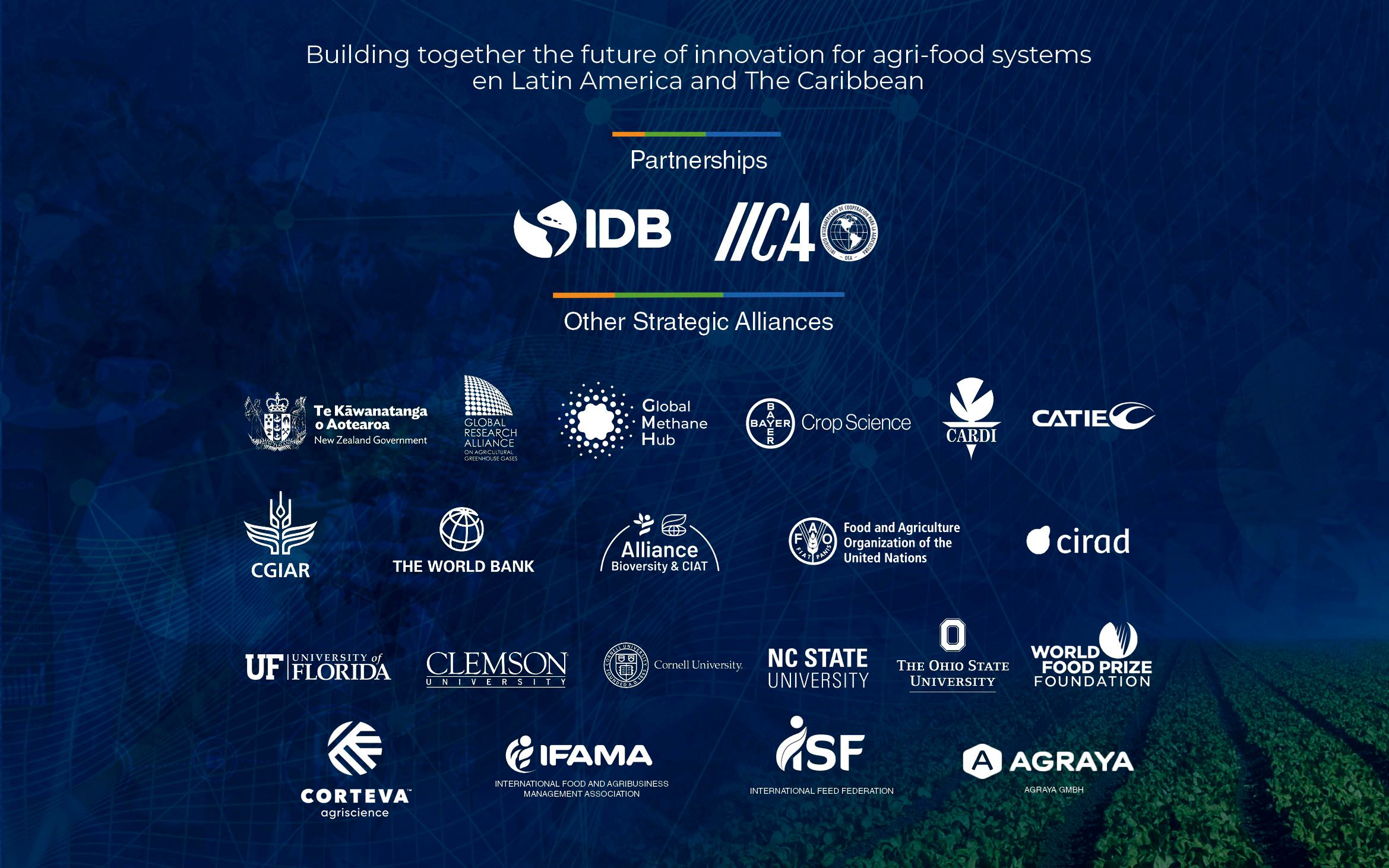
A unique mechanism worldwide for the strategic and sustainable co-financing of agricultural research, development and innovation (R&D&I) in Latin America and the Caribbean. Created in 1998, its legal representative is the IDB and its administrator is IICA.
It is made up of fifteen member countries: Argentina, Bolivia, Chile, Colombia, Costa Rica, Dominican Republic, Ecuador, Honduras, Nicaragua, Panama, Paraguay, Peru, Spain, Uruguay and Venezuela, represented by their national agricultural research and innovation institutes (NARIs), which make up the Board of Directors.
Its governance comprises the Board of Directors, the Executive Committee, the Finance Committee and the Technical Administrative Secretariat. Member countries have contributed capital of US$ 83.05 million and, as of December 31, 2025, the investment portfolio reached US$ 103.63 million.
Cumulative co-financing 1998–2026
US$ 168.4 million
Every dollar invested by FONTAGRO mobilizes more than three dollars from other sources.
Regional context
Challenges and Opportunities of the Decade
Latin America and the Caribbean has the opportunity to build public-private innovation systems with FONTAGRO: a network of 15 countries where cooperation becomes R&D&I with impact.
Global trends to 2034
Source: OECD–FAO, Agricultural Outlook 2025–2034.

Challenges facing the region
Geopolitical disruptions
Events that disrupt value chains and shape the decisions of political and economic actors.
Abrupt climate events
Droughts, floods and extreme temperatures that suddenly affect primary agricultural production.
Rural-to-urban migration
The loss of rural labor calls for technologies that raise productivity and make farming an attractive activity.
Sustainable funding for R&D&I
Stable investment to renew talent and strengthen the capacities of public research organizations.
Public-private partnerships
Linking science and business so that technologies reach the market and the farmer.
FONTAGRO's response
Regional co-financing, multi-stakeholder consortia and public goods that turn these challenges into innovation opportunities.
Regional Presence
Where We Work
A network with two complementary layers: a small and very stable core of national institutes acting as recurring counterparts, and a broad and diverse base of partners that is constantly renewed.
Share of ordinary capital (US$ 83.05 M)
Distribution of 2026 operations by region
Consortia of the 93 projects approved 2017–2026
participations
- National Institutes21.6%
- Regional Universities21.0%
- Producer Associations19.6%
- Regional Institutions11.2%
- Private Companies9.8%
- Regional Governments7.8%
- International Institutes5.6%
- Extra-regional Universities3.4%
89%
of the projects include a National Institute: 16 institutes with an average recurrence of 6.75 years each.
79%
of the institutions took part in a single year: an open network that keeps renewing itself.
30th Annual Meeting · Lima, Peru
Letter from the President
“It is an honor to address you as President of FONTAGRO in a particularly significant year, in which Lima hosts the 30th Annual Meeting of the Board of Directors.”
On the financial front, the audited report as of December 31, 2025 recorded a fund value of US$ 103.7 million, 3.8% higher than in December 2024. The investment portfolio reached a market value of US$ 103.63 million (+4.9%) and, on May 31, 2026, a US$ 6.0 million bond maturing in 2031 was reinvested at a rate of 4.125%.
The 2026 Call for Proposals, the first under the 2025–2030 Medium-Term Plan, received 130 proposals, of which 47 scored above 75 points. The Board authorized funding for five projects, one per Flagship Program, and for seven projects by consensus addressing threats of regional scope.
On the institutional front, the new IDB–IICA–FONTAGRO Tripartite Agreement and its Operating Guide were established on March 20, 2026. Challenges lie ahead that require joint attention: accelerating portfolio execution, planning the renewal of the bonds maturing in 2028 and regularizing outstanding capital contributions.
Christian Barrantes Bravo
President · FONTAGRO
Executive President, INIA Peru
Executive Committee

Christian Barrantes Bravo
President · FONTAGRO
Executive President, INIA Peru

Miguel Serrano López
Vice President · FONTAGRO
Executive Director, AGROSAVIA Colombia

Eugenia Saini
Executive Secretary · FONTAGRO
“In 2026 we reaffirmed our conviction that science, innovation and international cooperation are the best response to the shared challenges of the region.”
Message from the Executive Committee
Overview of the period · as of August 31, 2026
Main Results 2026
First year of the 2025–2030 Medium-Term Plan and launch of the new operating model with the IDB and IICA. A year of financial strength, more projects addressing regional threats and a leap in knowledge production.
Financial strength
US$ 103.7M
Audited fund value as of 12/31/2025 ▲ 3.8%
US$ 103.6 M
Investment portfolio at market value +4.9%
+12%
Payment commitments, driven by higher project approvals
US$ 6.0 M
Bond reinvested to 2031 at a 4.125% rate
Unqualified
Ernst & Young's opinion on the 2025 financial statements
Co-financing since 1998
227 projects
co-financed for a total of US$ 168.4 million
62
Active operations totaling US$ 14.9 M (total investment US$ 46.1 M)
3.43 : 1
Leverage 2018–2026; up to 3.61 with the CAF initiative
Call for proposals and knowledge
130
proposals in the 2026 Call; 47 scored above 75/100
5 + 7
projects: one per Flagship Program and seven projects by consensus
22,793
social media followers +30%
H 42
H-index · 7,274 citations
387
researchers trained in scientific writing and project design (2021–2026)
914
product reviews to ensure scientific quality (last three years)
3 committees
KM&C, Scientific, and the new Markets and International Relations Committee
The new IDB–IICA–FONTAGRO Tripartite Agreement and its Operating Guide are signed: the administrative budget and project financing are now executed through IICA, and the Operations Manual is updated.
Co-financing 1998–2026
Evolution of Funding
Funding structure of operations by year, in US$ millions. Years without a bar correspond to periods without sufficient funding for operational activities.

Leverage
2.70 → 3.43
2011–2017 compared with 2018–2026. Up to 3.61 if the US$ 8.0 M initiative with CAF is included.
2025–2030 Medium-Term Plan · first year
Our Identity and Flagship Programs
01Vision
To transform agrifood systems through knowledge so that they become more inclusive and sustainable for the environment and society.
02Mission
To lead regional coordination, cooperation and dialogue through the sustainable co-financing of public goods initiatives that contribute to knowledge and innovation in agrifood systems and to improving people's quality of life.
03Values
Integrity, Solidarity, Effectiveness, Transparency and Respect.
Transformation of resilient and carbon neutral crop systems
Transformation of livestock and animal protein systems: productive efficiency with a lower environmental footprint
Impact 2030: effective scaling of R&D&I through new models of extension, technology transfer, and public-private partnerships
Digital revolution in agriculture: robotics and AI for regional innovation
The Future Food Basket: diversification and biodiversity use for sustainable nutrition
Science for evidence-based policymaking
Regional R&D&I Platforms
Innovation Laboratories
Every FONTAGRO project is an innovation laboratory: a consortium of at least two member countries that shares problems, capacities and solutions. The map shows portfolio projects by executing and co-executing country.

Thematic focus of the portfolio
FONTAGRO projects: sectors and topics
An agenda to increase the productivity and value of food, strengthen resilience and reduce environmental impact.
Efficient and sustainable production
Water, nutrients and forage resources; soils, biodiversity and production integration; efficient livestock farming, animal welfare and measurement of emissions and carbon.
Climate adaptation and plant and animal health
Adapted genetics, local varieties, pest diagnosis and surveillance, biological control and healthy planting material.
Quality food and territorial value
Nutritional quality, local crops, origin-based differentiation, loss reduction and waste valorization.
Biotechnology, nanotechnology and digital tools
Biologicals, nanomaterials, sensors, satellites, agronomic models and artificial intelligence.
Regional cooperation to validate and scale up
Trial networks, shared protocols and partnerships among science, businesses and producer organizations.

Portfolio monitoring · as of August 31, 2026
Portfolio and Execution 2026
The TAS supports executing teams throughout the project cycle, from design to technical, administrative and financial closure, with weekly monitoring in the IDB and IICA systems.
Active portfolio
62 operations
55 active projects and 7 under audit
US$ 14.94 M
FONTAGRO and other agencies' contribution
US$ 46.06 M
total investment including counterpart funding
Financial execution
52%
overall portfolio disbursement
US$ 7.72 M
cumulative disbursement
US$ 3.10 M
2026 annual disbursement
New operating model
US$ 3.90 M
operations administered by the IDB
US$ 9.30 M
operations administered by IICA
US$ 485,138
funds recovered from closed operations since 2024 (including US$ 100,834 in process)
Ongoing training
Weekly sessions on procurement, financial management, indicators, reporting and results communication.
Process standardization
Forms, guidelines and tools aligned with IDB, IICA and FONTAGRO requirements.
Tailored assistance
Direct support on operational, technical-scientific, legal and financial issues.
Audit and transparency
Coordination of external audits and implementation of recommendations.
Programmatic activities
2026 Call for Proposals and Agro-bioentrepreneurship Competition
First call aligned with the 2025–2030 MTP: “Cooperation and innovation to drive more productive, profitable and competitive agrifood systems with a lower environmental footprint in LAC”.See calls for proposals →
| FP | Project | FONTAGRO | Counterpart | Total (US$) |
|---|---|---|---|---|
| FP 1 | Validation and scaling of advanced fertilization technologies for more productive and sustainable agriculture | 250,000 | 608,472 | 858,472 |
| FP 2 | Integrated cattle production systems to raise productivity, profitability and sustainability while reducing the carbon footprint in Argentina and Colombia | 250,000 | 500,000 | 750,000 |
| FP 3 | Regional scaling of a sustainable technology to improve nutritional quality in Northwest Argentina (NOA) and Uruguay | 248,901 | 522,000 | 770,901 |
| FP 4 | AI-based digital platform for estimating and forecasting yield potential | 249,998 | 500,454 | 750,452 |
| FP 5 | Scaling resilient production and integrated processing of Lupinus mutabilis for Andean food security | 250,000 | 500,000 | 750,000 |
| Total 2026 Call | 1,248,899 | 2,630,926 | 3,879,825 |
With IICA · Bioeconomy and Innovation Program
Agro-bioentrepreneurship Case Competition
Identifies, documents and disseminates successful experiences of innovation and entrepreneurship in the bioeconomy across the region. Approved by the Board of Directors with an allocation of US$ 200,000; 30 initiatives are currently in acceleration and incubation processes.
See initiatives and competitions →Ongoing training
Training for project teams
Virtual and in-person workshops for NARI researchers, IICA specialists and project teams on proposal design, management, monitoring and scientific writing; a weekly training session (Fridays) and the Science Café (Thursdays).
See training activities →Programmatic activities
Projects by Consensus Science Week
Projects by Consensus respond to threats and opportunities of regional scope identified by member countries and are aligned with the Flagship Programs of the 2025–2030 MTP. 7 projects approved in 2026 with US$ 1.85 M from FONTAGRO (including US$ 100,000 from 2027).
Risk management of Fusarium TR4 and other banana and plantain diseases
Colombia · Ecuador · Peru · Venezuela · Spain
US$ 250,000Genetic improvement and bioproduction for the banana value chain
Argentina · Paraguay · Bolivia · Colombia
US$ 250,000Validation network for climate-resilient coffee hybrids and varieties
CATIE · Peru · Honduras · Nicaragua · Venezuela
US$ 300,000Regional network for the evaluation of cacao cultivars
CATIE · Peru · Venezuela
US$ 300,000FRONT-AL Platform: first line of defense for fruit production against HLB
Argentina · Colombia · Venezuela · Costa Rica
US$ 250,000Integrated management of New World screwworm
Argentina · Uruguay · Colombia · Venezuela
US$ 250,000Local seed systems through public-private partnerships (with IFAMA)
Costa Rica · Honduras · Peru
US$ 250,000XXI Annual Technical Monitoring Workshop of Projects: presentation of progress and results, exchange of experiences and network strengthening, with sessions on science communication and administrative management.
See Event →Resource mobilization and new agendas
Strategic Initiatives
World Bank · Flagship Program 6
How can public-private partnerships be promoted to increase investment in R&D&I?
Study on the role of the public policies governing NARIs. A five-dimension framework (governance, coordination, capacities, demand orientation and operating rules), validated with more than 30 stakeholders in 15 countries. The AI-based self-diagnosis tool NARI PPP Capacity Self-Assessment was created, and the technical dialogue “Connect to Innovate” brought together more than 40 leaders.
Connect to Innovate →CAF · IICA · FONTAGRO
Agroclimatic Innovation Accelerator for Adaptation through Science-Community Partnerships in LAC
US$ 8.0 million proposal submitted to the Adaptation Fund Climate Innovation Accelerator (AFCIA). It envisages calls for grants of up to US$ 250,000 for at least 20 projects that bring together science and communities, focusing on small and medium-scale producers, Indigenous peoples, women and youth. Under evaluation.
Adaptation Fund →IICA · U.S. universities
Feed the Future Innovation Labs
FONTAGRO and IICA were invited as regional partners in proposals led by the University of Florida, Ohio State University, University of Maryland Eastern Shore, Virginia Tech, Clemson University, North Carolina State University and the University of Minnesota. The University of Florida proposal advanced to the full proposal stage.
Support to member countries · Dominican Republic
IDIAF Knowledge Management Strategy
The Executive Secretariat supported the Dominican Institute of Agricultural and Forestry Research (IDIAF) through every phase: institutional diagnosis, strategic lines, action plan and validation, with the backing of the IICA Delegation in the country.
More information →Status of contributions and leverage by country
Administration and Finance
| Member country | Commitment | Contribution (C) | FONTAGRO (A) US$ | Other agencies (B) US$ | Participated | Led | Leverage (A+B)/C |
|---|---|---|---|---|---|---|---|
| Argentina | 20,000 | 20,000 | 5,936,298 | 2,158,556 | 100 | 37 | 0.40 |
| Bolivia | 2,500 | 2,500 | 1,677,757 | 861,972 | 45 | 7 | 1.02 |
| Chile | 2,500 | 2,500 | 2,475,533 | 1,384,187 | 63 | 19 | 1.54 |
| Colombia | 10,000 | 10,000 | 5,959,732 | 3,818,017 | 105 | 43 | 0.98 |
| Costa Rica | 681 | 681 | 2,671,022 | 2,268,613 | 70 | 19 | 7.25 |
| Ecuador | 2,500 | 2,500 | 2,054,999 | 725,461 | 54 | 8 | 1.11 |
| Dominican Republic | 2,500 | 2,500 | 677,064 | 584,841 | 40 | 2 | 0.50 |
| Honduras | 2,500 | 2,500 | 628,734 | 390,704 | 30 | 1 | 0.41 |
| Nicaragua | 2,500 | 1,000 | 1,200,121 | 636,706 | 39 | 3 | 1.84 |
| Panama | 5,000 | 5,000 | 1,093,054 | 744,684 | 47 | 8 | 0.37 |
| Paraguay | 2,500 | 2,000 | 427,814 | 274,813 | 34 | 0 | 0.35 |
| Peru | 2,500 | 2,500 | 2,403,158 | 2,399,513 | 59 | 11 | 1.92 |
| Spain | 14,723 | 14,723 | 721,495 | – | 24 | 3 | 0.05 |
| Uruguay | 5,000 | 2,500 | 3,204,473 | 1,478,125 | 67 | 18 | 1.87 |
| Venezuela | 12,000 | 12,000 | 615,414 | 468,333 | 34 | 0 | 0.09 |
| IDRC (Canada) | 100 | 146 | |||||
| Total | 87,504 | 83,050 |
Information as of July 31, 2026. Commitment and contribution in thousands of US$. Leverage: dollars received by the country for each dollar contributed (not adjusted for inflation). Highlighted in green: countries with a return greater than 1. US$ 4.5 M pending payment: Uruguay (2.5), Nicaragua (1.5) and Paraguay (0.5).
Synergies and resource mobilization
Partnerships and Memberships
Every institutional link is a concrete opportunity for synergy: sharing knowledge, mobilizing complementary resources, avoiding duplication and generating joint impact.
Private sector
Meetings with Bayer, Corteva and BASF, and with U.S. producer associations and chambers linked to soybeans, grains and the meat industry (Meat Institute), to explore co-financing, technology transfer and scaling.
Multilateral organizations
Ongoing dialogue with FAO, the IDB, the World Bank and CAF, Virginia Tech's GAP Report, the Innovation Labs, the U.S. Department of State and U.S. universities.
Young talent and new proteins
Opportunity with the World Food Programme (WFP) for exchanges of young researchers with the United States, and collaboration with The Good Food Institute on alternative proteins.
Network of hemispheric centers
PROCINORTE, 1890 Foundation, CATIE (MOU in progress), CIMMYT, CIP, CIAT, Bezos Earth Fund and IICA: economies of scale in research and access to climate finance.
Agrinatura and the European Union
Agrinatura (more than 40 European universities and research centers) sent a formal letter of interest for a strategic partnership and an MOU, which will open the door to bi-regional consortia and European calls for proposals.
New stakeholders
Michigan State University and Kansas State University, the latter in connection with New World screwworm, expressed interest in partnering with FONTAGRO.
Memberships
FONTAGRO remained in contact with Nicaragua, Paraguay, and Uruguay regarding their outstanding capital contributions, while discussions continued with Guatemala, El Salvador, Mexico, and Brazil about their interest in joining the Fund.
Strategic Partnerships in Action
MPI New Zealand · GRA
16 years of cooperation for lower-emission livestock and agriculture
The partnership with New Zealand's Ministry for Primary Industries and the Global Research Alliance on Agricultural Greenhouse Gases has evolved toward solutions that integrate measurement, management and decision support: livestock feeding, satellite monitoring of forage, soil carbon, nitrogen use efficiency, biologicals and silvopastoral systems.

Global Methane Hub
Measure to act: from satellite monitoring of rice to livestock in the Gran Chaco
Rice: an open-access tool combining satellite information, AI and field data to estimate methane emissions (Uruguay, Panama, Peru, Colombia, Costa Rica, the United States and New Zealand).
Gran Chaco: a network of 26 pilot sites in Argentina, Bolivia and Paraguay to reduce emissions per kilogram of beef produced.
Publication in preparation: FONTAGRO – Global Methane Hub and its impact in Latin America and the Caribbean.
Global Methane Hub →U.S. universities
University of Florida and Clemson University
Scientific partners of the coffee and cacao projects by consensus (regional networks led by CATIE). The University of Florida also supports the FRONT-AL platform against HLB, the New World screwworm project and RECSO-Americas.
See NWS project → See FRONT-AL project → See RECSO-Americas project →PRIVATE SECTOR
Regenerative agriculture and local seed systems
Bayer co-finances the regenerative agriculture project in Argentina and Paraguay; Corteva joins the cultivar evaluation in the sorghum project. The FONTAGRO–IFAMA partnership, with ISF and Agraya, strengthens seed production in Costa Rica, Honduras and Peru under the “Clean Seed” scheme: at least 2,500 producers, with the potential to scale to more than 150,000.
See regenerative agriculture with Bayer→ See sorghum cultivation with Corteva → See IFAMA →KM&C Action Plan 2025–2030
Knowledge Management and Communication
Since the Board of Directors' mandate in 2015, KM&C has evolved from a visibility-centered model to a comprehensive approach to strategic knowledge management, science communication and innovation.
Regional platform and forum for open science and collaboration
Technical committees, South–South and North–South cooperation, open technical dialogues and multi- and interdisciplinary consortia.
Digital innovation, artificial intelligence and decision intelligence
New website and project platform, databases, institutional Dashboard and regional knowledge repository.
Strategic communication, institutional capacities and impact
Multichannel communication, new formats, continuous training and brand strategy.
Three committees that strengthen the 2025–2030 MTP
KM&C Committee
Brings together specialists from the 15 NARIs and IICA. In 2026: a meeting on scientific branding and AI with more than 30 specialists, communication best practices with 20 focal points, and the AI-powered International Certification in Strategy and Political Communication (The George Washington University) with 11 representatives.
Scientific Committee
A foresight space that keeps the scientific agenda up to date. Together with the University of Florida, it organized workshops on citrus HLB and New World screwworm (USDA-ARS, IICA, Texas A&M, FAO, WOAH, among others), which agreed on two regional projects.
Markets and International Relations Committee
A new Flagship Program 6 committee so that market access negotiations are grounded in scientific evidence: sanitary and phytosanitary measures, traceability, geographical indications and biosafety. Inaugural workshop scheduled for November 2026.
Indicators as of August 31, 2026
Knowledge and Communication Results
FONTAGRO's digital community grew 30% year on year and 68% since 2024. Workshops and seminars rose from 247 to 577 (+134%).
Knowledge and outreach products
1,794 +64%
Social media followers
| Indicator | 2024 | 2025 | 2026* |
|---|---|---|---|
| Total social media impressions | 576,826 | 215,534 | 707,351 |
| New Instagram followers | 315 | 482 | 2,410 |
| YouTube views | 21,519 | 36,800 | 46,600 |
| YouTube channel subscribers | 1,233 | 1,959 | 2,758 |
| Average monthly engagement | 6.5% | 6.5% | 6.5% |
* 2026: partial period through August 31. LinkedIn is the network with the largest number of followers.
Multichannel science communication
New Formats and Digital Platform
Science Voices
One-minute clips in which researchers share the impact of their projects. +10,000 views.
FONTCAST
AI-produced, scientifically verified podcasts that translate projects into plain language. +5,000 views.
“In the voice of”
A monthly space that gives voice to the directors of the 15 member NARIs.
AGROChamps
Monthly recognition of outstanding researchers for their career or awards.
Science Stories
Visual storytelling that presents each project dynamically.
FONTAGRO Forward and Next
Monthly and weekly summaries of project progress and events.


Technological and scientific impact
Science, Technology and Impact
Projects do not stop at generating knowledge: they develop prototypes and validate them in settings increasingly close to real production conditions.
Technology Readiness Level (TRL) of 78 completed projects

Scopus-indexed publications
232
papers 2002–2026 acknowledging FONTAGRO
7,274
citations · H-index of 42
×3.6
annual average: from 6.5 (2014–2019) to 23.5 (2020–2025)

Policy influence
Emissions studies have contributed to national inventory methodologies; irrigation and pest management strategies have been incorporated into extension programs and technical regulations.
Regional collaborative science
Multi-country platforms that compare approaches and adapt solutions: HLB in Argentina, Paraguay, Uruguay and Bolivia; family livestock farming in Uruguay and Argentina; digital irrigation in Chile, Argentina, Uruguay and Colombia.
An agenda that connects
Trial networks, shared protocols and collaboration among science, businesses and producers to compare, adapt and scale solutions.
Capacity Building and Scientific Quality
387 researchers and technicians
trained in 10 postgraduate courses (2021–2026)
914 product reviews
over the last three years: 560 original submissions and 354 reviews of revised versions
A request for changes is not a rejection of the work: it is a process of improvement and support that strengthens the scientific rigor, alignment with objectives and communication quality of each product.
In addition, 25 weekly Integrated Project Management sessions for more than 100 participants, and two webinars on generative AI in research, among the five most viewed on the platform.
2026 Portfolio · 62 operations
Active Projects
Regional research, development and innovation consortia transforming the agrifood systems of Latin America, the Caribbean and Spain. The lead institution and country of each project are shown.

- 1
Nanofertilizers to improve nitrogen use efficiency in wheat, maize and coffee→
IICA/INTA · Argentina - 2
Integrated cattle production systems: toward sustainable livestock farming in Argentina and Colombia→
IICA/AGROSAVIA · Colombia - 3
Value added at source: high-quality soybean flour for food programs→
IICA/ITANOA · Argentina - 4
Artificial intelligence for estimating and forecasting rainfed yield potential→
IICA/INTA · Argentina - 5
From the Altiplano to the table: production and processing of tarwi in Bolivia and Ecuador→
IICA/UMSA · Bolivia - 6
Molecular diagnostics and artificial intelligence to anticipate citrus greening in Latin America→
IICA/INTA · Argentina - 7
Risk management of Fusarium (TR4) and other banana and plantain diseases in Latin America and Spain→
IICA/AGROSAVIA · Colombia - 8
New varieties and biologicals to strengthen subtropical banana production→
IICA/INTA · Argentina - 9
Integrated management of New World screwworm→
IICA/INTA Argentina and INIA Uruguay - 10
Regional Network for Cultivar Evaluation, productivity gap reduction and innovation transfer (RECSO-Americas)→
IICA/INTA · Argentina - 11
Regional cooperation on regenerative agriculture→
IICA/INTA · Argentina - 12
Sustainable management of creole cattle genetic resources→
IICA/AGROSAVIA · Colombia - 13
Regional platform to boost the competitiveness of Andean avocado→
IICA/INIA · Peru - 14
Carbon gaps and service crops→
IICA/FAUBA · Argentina - 15
Climate resilience of the quinoa agrifood system→
IICA/INIAF · Bolivia - 16
Innovation and nature for water management→
IICA/AGROSAVIA · Colombia - 17
Biologicals: evidence for their adoption→
IICA/AGROSAVIA · Colombia - 18
Resilient Maize: innovation and sustainable management of corn stunt→
IICA/AGROSAVIA · Colombia - 19
Restoration of soil organic carbon: contribution of no-tillage systems→
INTA/Fundación ArgenINTA · Argentina - 20
Sustainable livestock farming for the development of the Gran Chaco→
INTA/Fundación ArgenINTA · Argentina - 21
Integration of production systems as a strategy for climate change mitigation and adaptation→
INTA/Fundación ArgenINTA · Argentina - 22
Integration of sorghum cultivation into production systems of the Central American Dry Corridor→
IICA/INTA · Costa Rica - 23
New Horizons in AgTech: scaling innovation in pastoral systems in Latin America and the Caribbean→
INIA · Uruguay - 24
Reducing GHG emissions in potato-pasture systems in Ecuador and Peru→
IICA/INIAP · Ecuador - 25
Climate-resilient wheat→
Universitat de Lleida · Spain - 26
Strengthening the management of the potato purple top complex→
IICA/INIAP · Ecuador - 27
Development and use of biologicals for sustainable agriculture in Latin America→
IICA/INTA · Costa Rica - 28
Resilient native potatoes: safeguarding food security in the face of climate change→
IICA/UMSA · Bolivia - 29
Use, production and trade of seed potatoes in Latin America and the Caribbean→
INTA/Fundación ArgenINTA · Argentina - 30
Development of a genetic improvement network in LAC to promote resilient and nutritious agriculture→
IICA/INTA · Costa Rica - 31
FONTAGRO Annual Operating Plan 2025-2028→
FONTAGRO TAS · Regional project - 32
Strengthening the competitiveness of mango producers in Colombia and Peru→
Universidad del Tolima · Colombia - 33
Multifunctional bioprotectors for postharvest fruit→
UTN · Ecuador - 34
Multifunctional landscapes in extensive agroecosystems→
CEUTA · Uruguay - 35
Sustainable tropical dairy systems→
IICA/UNICAUCA · Colombia - 36
Climate-smart livestock farming in Mapuche communities (FTG)→
INTA/Fundación ArgenINTA · Argentina - 37
Climate-smart livestock farming in Mapuche communities (MPI-NZ)→
INTA/Fundación ArgenINTA · Argentina - 38
Optimizing nitrogen use: higher production and lower impact (N4R) (FTG)→
INIA · Chile - 39
Optimizing nitrogen use: higher production and lower impact (N4R) (MPI-NZ)→
INIA · Chile - 40
FONTAGRO Seed Fund→
FONTAGRO TAS · Regional project - 41
Online crop management support platform→
IICA/UACH · Chile - 42
Network of resilient farms with sustainable forest management→
INTA/Fundación ArgenINTA · Argentina - 43
Tropical Agriculture 4.0: efficient water management→
AGROSAVIA · Colombia - 44
One Welfare for the resilience of livestock farms→
INTA/Fundación ArgenINTA · Argentina - 45
Innovations to reduce methane emissions in ruminants→
AGROSAVIA · Colombia - 46
Platform for the transfer and use of biologicals→
CEAZA · Chile - 47
Climate change resilience through the use of bioproducts→
AGROSAVIA · Colombia - 48
Sustainable livestock farming in the Amazon of Peru and Ecuador→
IICA/UNALM · Peru - 49
Satellite monitoring of methane in rice crops→
IICA/INIA · Uruguay - 50
Vertical farming: innovation for horticulture in Latin America and the Caribbean→
IICA/IDIAP · Panama - 51
Regional alliances for the dissemination of iron-rich beans in Latin American countries→
IICA/IDIAP · Panama - 52
Multipurpose silvopastoral systems and family livestock farming→
AGROSAVIA · Colombia - 53
Prevention and management of Fusarium wilt of bananas and plantains→
AGROSAVIA · Colombia - 54
Soil carbon sequestration opportunities in Latin America and the Caribbean (MPI-NZ)→
INIA · Uruguay - 55
Soil carbon sequestration opportunities in Latin America and the Caribbean (FTG)→
INIA · Uruguay - 56
Higher agricultural production with lower nitrous oxide emissions→
INTA/Fundación ArgenINTA · Argentina - 57
Satellite monitoring of biomass quantity and quality (FTG)→
INTA/Fundación ArgenINTA · Argentina - 58
Satellite monitoring of biomass quantity and quality (MPI-NZ)→
INTA/Fundación ArgenINTA · Argentina - 59
Sustainable irrigation and fertilization management in quinoa→
IICA/FAUBA · Argentina - 60
Geographical indications for Mesoamerican cacao→
IICA · Costa Rica - 61
Climate-resilient potatoes→
IICA/AGROSAVIA · Colombia - 62
Nanotechnology in agricultural soil moisture management→
IICA/PROINPA · Bolivia
Acknowledgments
Our Thanks
The Board of Directors thanks Dr. Muhammad Ibrahim, Director General of IICA, and the team of the Bioeconomy and Innovation Program; the IDB, in particular the Environment, Rural Development and Risk Management Division, the Office of Outreach and Partnerships, and the Legal and Finance departments; the World Bank and CAF for their joint work on strategic initiatives; and the partners who broaden FONTAGRO's reach: New Zealand's MPI, GRA, Global Methane Hub, U.S. universities, Agrinatura and the private sector.
Special recognition goes to INIA Peru as host of the 30th Annual Meeting in Lima, to INTA Costa Rica and the IICA Delegation in that country, and to the Technical Administrative Secretariat for its commitment in a year of dual institutional transition.