 Impact
 Initiatives
 Dashboard
 Alliances

 Impact
 Initiatives
 Dashboard
 Alliances
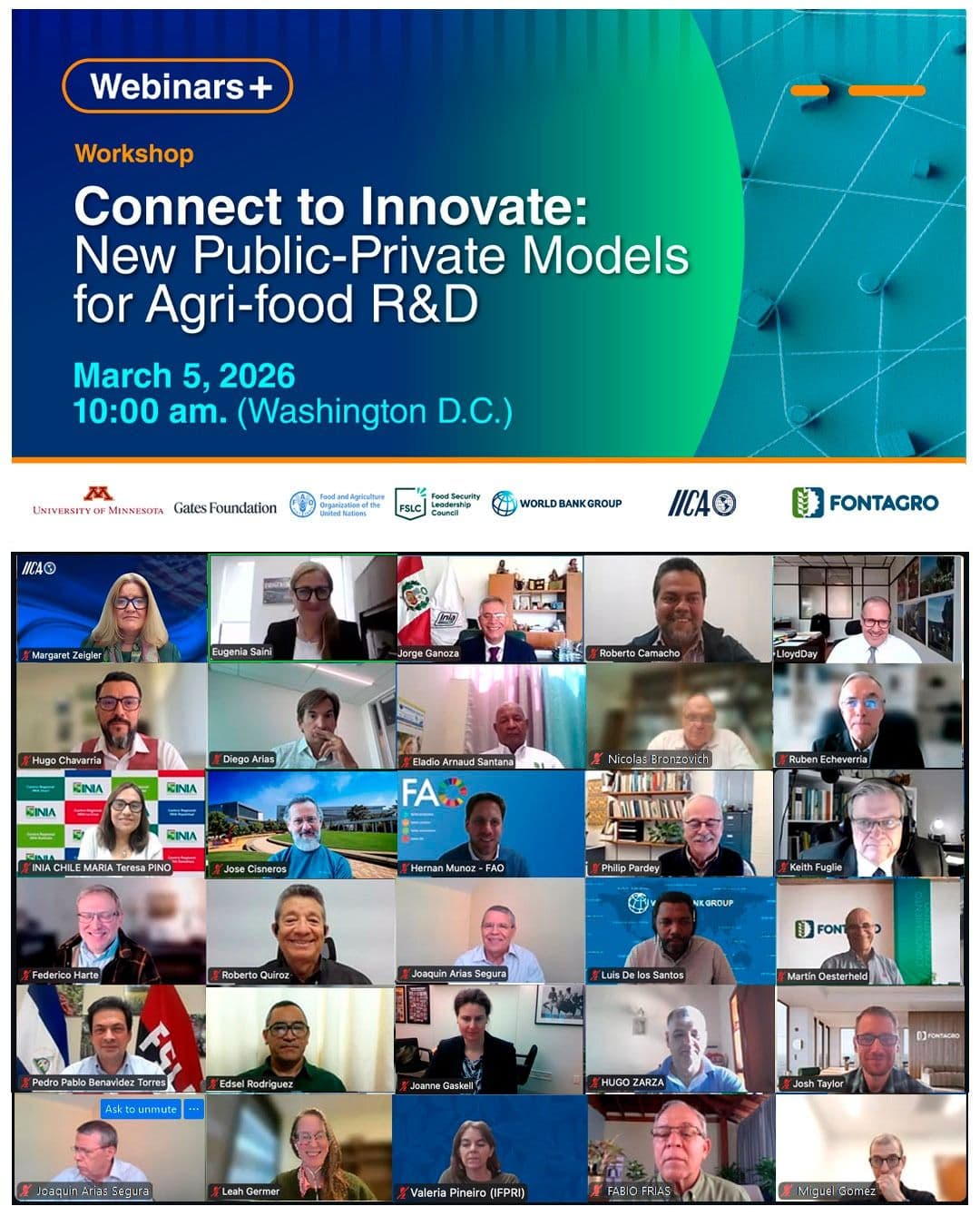
On March 5th, the first virtual meeting of the FONTAGRO Scientific Committee was held under the theme "Connect to Innovate: New Public-Private Models for Agri-Food R&D." The event, organized in collaboration with the World Bank Group and the Inter-American Institute for Cooperation on Agriculture (IICA), brought together over 40 leaders and experts in agri-food systems from Latin America and the Caribbean (LAC), with the participation of prominent specialists from the University of Minnesota, FAO, Food Security Leadership Council, and the Gates Foundation. The meeting was inaugurated by Jorge Ganoza Roncal, President of FONTAGRO and INIA Peru.
Subsequently, during a panel moderated by Eugenia Saini, Executive Secretary of FONTAGRO, and Diego Arias, Manager of the Global Agriculture and Food Practice for LAC at the World Bank, valuable analyses were shared regarding global and regional trends in agricultural research investment. Among the highlighted interventions:
- 🔹 Phil Pardey, Director of the GEMS Informatics Center at the University of Minnesota, analyzed structural changes in global investment in agri-food R&D, highlighting the growing prominence of middle-income countries and the private sector.
- 🔹 Keith Fuglie, Chief Economist of the Food Security Leadership Council, emphasized the importance of investment in research to drive sustainable agricultural productivity growth, proposing new public-private partnership mechanisms to strengthen innovation in LAC. (View presentation)
- 🔹 Rubén Echeverría, Senior Agricultural Development Advisor at the Gates Foundation, highlighted the strategic role of regional research organizations in addressing common challenges among countries and the need to strengthen their funding.
- 🔹 Hernán Muñoz, Statistical Lead of FAO's ASTI program, presented preliminary findings from the new dataset on agricultural R&D investment in the region.
These high-level meetings contribute to the development of a policy document within the framework of FONTAGRO's flagship Program #6 of the Medium-Term Plan (MTP) 2025–2030, aimed at identifying opportunities to strengthen regional and international cooperation in public-private agricultural research and development.
As a result of the dialogue, three key areas for institutional reforms were identified to strengthen agricultural innovation systems in Latin America and the Caribbean:
- 1. Modernize the governance of agricultural research systems by updating the institutional frameworks of national research institutes and strengthening their coordination with universities, ministries, and the private sector.
- 2. Develop new financing models for innovation, including matching fund schemes, sectoral funds, and public-private partnerships that mobilize greater investment in R&D.
- 3. Strengthen technology transfer systems and scaling of innovations to close the gap between research and adoption and ensure that scientific advances effectively reach producers and agri-food chains.
Watch the recording of this meeting here.
We thank all participants for their valuable contributions and for continuing to build together the future of agri-food innovation in Latin America and the Caribbean.