



 Impact
 Initiatives
 Dashboard
 Alliances

 Impact
 Initiatives
 Dashboard
 Alliances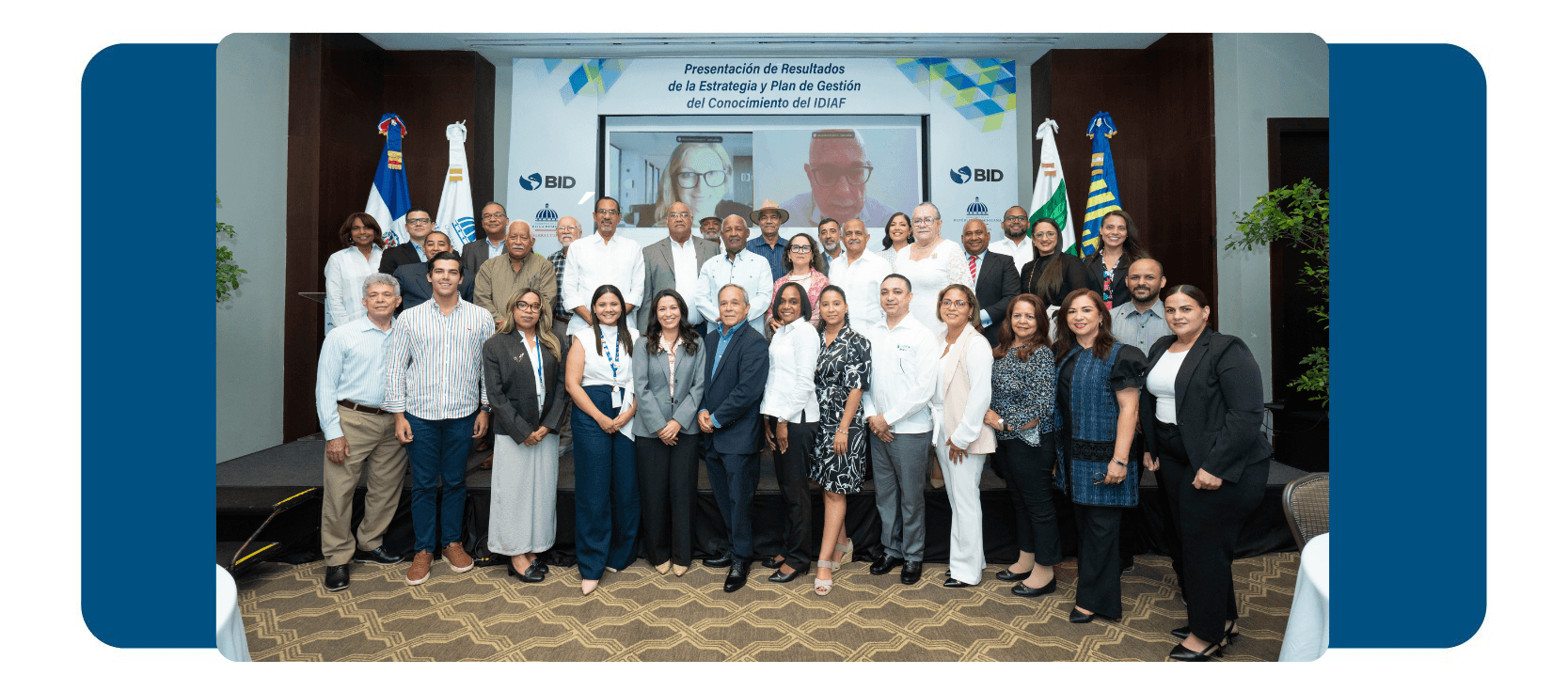
This September, the Dominican Institute of Agricultural and Forestry Research (IDIAF) presented the results of its Knowledge Management Strategy and Plan at an event attended by agricultural sector officials and representatives from international cooperation agencies. Formulated in alignment with IDIAF’s 2020–2030 Strategic Plan, the Strategy addresses findings that identified strong technical capabilities alongside gaps in system interoperability and the systematization of lessons learned. To this end, it proposes a cross-cutting governance pillar—involving the creation of a Knowledge Management Committee—and four pillars focused on validating and preserving institutional knowledge, strengthening its transfer at the local level, fostering cooperation and communities of practice, and advancing toward interoperability and open science.
The Strategy was developed by international specialists: Dr. José María García Álvarez-Coque, Professor of Applied Economics at the Polytechnic University of Valencia, with four decades of experience in agri-food policy, social innovation, and family farming; and economist Carlos Ludeña, an international development specialist with extensive experience in climate variability, natural resources, and economic project analysis in Latin America and other regions. They worked in collaboration with Eugenia Saini, Executive Secretary of FONTAGRO. The process was also supported by the Inter-American Institute for Cooperation on Agriculture (IICA) Dominican Republic delegation, the Inter-American Development Bank (IDB), and IDIAF technical staff.
"How can we ensure that knowledge generated through research increasingly contributes to boosting productivity on the farm?" With this question, Darío Vargas Mena, Deputy Minister of Agricultural Extension and Training, opened one of the meeting's key discussions, highlighting that knowledge and innovation must be understood as a process connecting research, producers, universities, and extension services—a process that also originates and is continuously enriched within the territories themselves. He praised the Strategy as a timely tool for strengthening governance and organization, and expressed the Ministry of Agriculture's readiness to incorporate its findings into planning and extension processes, thereby aligning them more closely with territorial management and work with producers.
Along these same lines, Eladio Arnaud Santana, Executive Director of IDIAF, presented the institutional perspective on the challenges, priorities, and opportunities for strengthening the generation, transfer, and utilization of agricultural knowledge. He highlighted the institution's accumulated capabilities and experience in agricultural and forestry research and validation, noting how the new Strategy would allow for the further leveraging of this knowledge through technological innovation, scientific development partnerships, knowledge transfer, and the strengthening of specialized talent. As an initial step toward driving this initiative forward, he announced the formation of a Cross-cutting Knowledge Management Committee, which will progressively strengthen coordination, networking, communication, and knowledge management both within and outside the institution.
Gabriela Quiroga Gilardoni, representing IICA, joined in this call to action, highlighting the value of the knowledge the Dominican Republic has built over decades through its research capabilities, technical teams, projects, and accumulated experience in the agricultural sector. She noted that managing this knowledge makes it possible to protect and multiply the value of investments made in science, technology, and innovation—a message that aligns directly with the purpose of IICA’s technical cooperation in the country: strengthening institutional capacities and adding value to existing knowledge to generate sustainable results.
From a regional perspective, Eugenia Saini, Executive Secretary of FONTAGRO, highlighted the organization's role as a co-financing fund established by 15 countries to coordinate efforts and promote the development of technologies and innovations that contribute to transforming agrifood systems in Latin America and the Caribbean. She noted that increasing climate disruptions and the need to move toward more resilient and sustainable production systems pose new challenges for knowledge management and communication, requiring a rethinking of strategies for transferring technology and knowledge to producers. In this context, she emphasized that the joint IDIAF–IICA–FONTAGRO initiative serves as an example of how institutions with complementary capabilities and strengths can work collaboratively to modernize these processes. She also underscored the growing potential of digital tools and artificial intelligence to expand the reach, efficiency, and impact of knowledge and technology transfer. Finally, Saini acknowledged the support provided by IICA and the IDB for this initiative and encouraged IDIAF to continue identifying opportunities for cooperation and consortium-building with institutions from other countries in the region, leveraging this institutional strengthening process to drive new initiatives and participate in FONTAGRO’s 2027 Call for Proposals.
Building on this foundation, José María García Álvarez-Coque presented the Strategy’s key findings, challenges, and recommendations, which were developed based on the capabilities, experience, and knowledge accumulated by IDIAF throughout its history. The proposal rests on a solid foundation—the institution’s technical and scientific caliber, its territorial presence, its work with producers, and its cooperation networks—and outlines a path to strengthen how that knowledge is managed, disseminated, and utilized.
The event, organized by IDIAF with the support of IICA and the IDB, concluded with an exchange among participating authorities and institutions, reaffirming their shared commitment to advancing toward more coordinated knowledge management capable of multiplying the value of Dominican agricultural research and its impact in the field.