


 Impact
 Initiatives
 Dashboard
 Alliances

 Impact
 Initiatives
 Dashboard
 Alliances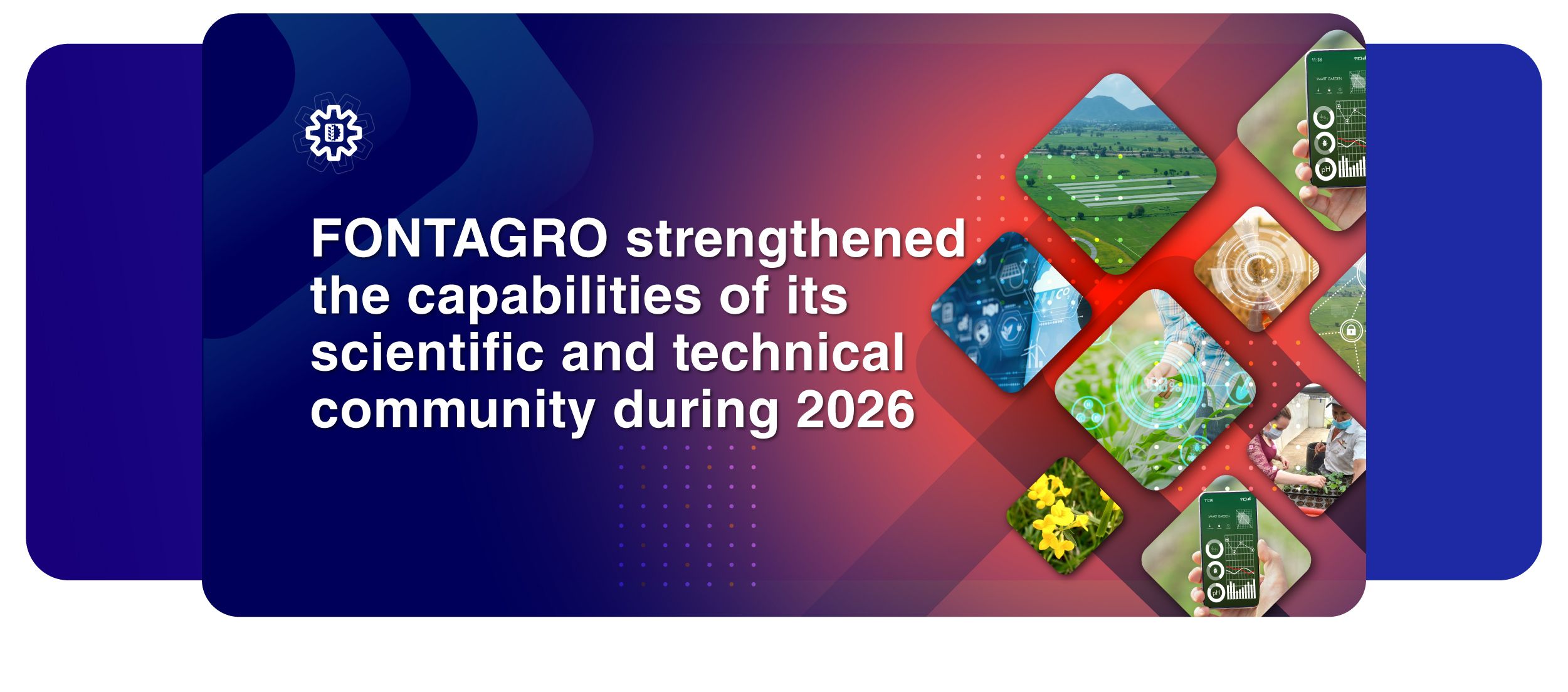
During 2026, FONTAGRO strengthened a broad agenda of training, updating, and exchange aimed at researchers, project leaders, knowledge management and communication (KM&C) officers, administrative staff, and representatives of the INIAs (National Institutes of Agricultural Research). The activities combined specialized training, practical tools, scientific foresight, and dialogue with national and international experts, in order to strengthen the capacities to generate, manage, communicate, and transfer knowledge for innovation in the agri-food systems of Latin America and the Caribbean.
Among the main initiatives is the Comprehensive Project Management program, which since February has held 25 virtual sessions with around 100 participants. The program covers financial planning and execution, technical aspects, delivery of outputs, use of the FONTAGRO Platform, and Knowledge Management and Communication.
Capacities for communicating research results were also strengthened through the Research Project Writing course, with 110 participants, and the Scientific Article Writing course, which reached 139 participants across its different editions. The latter was aimed at improving the preparation of articles for high-demand, high-impact scientific journals.
As part of the XXI Annual Technical Follow-up Workshop for Projects in Costa Rica, an in-person session was included on scientific communication, dissemination, social media, visual resources, artificial intelligence, financial planning, and procurement management.
At the institutional level, the Knowledge Management and Communication Committee brought together representatives from the 15 member countries to exchange best practices on scientific branding, artificial intelligence, content generation, storytelling, and audiovisual production. This agenda was complemented by the International Certification in AI-Powered Political Strategy and Communication, held between September and November through 10 virtual sessions, with participation from representatives of the Board of Directors and KM&C officers.
The training agenda was complemented by spaces for dialogue and foresight. Connecting to Innovate: New Public-Private Models for Agri-Food R&D, organized together with the World Bank Group and the Inter-American Institute for Cooperation on Agriculture (IICA), brought together more than 40 leaders to analyze new public-private models for agri-food R&D, with an emphasis on governance, financing mechanisms, and transfer and scaling. Likewise, the Transboundary Risk Management workshops "Regional Control of Citrus Greening: Science, Management and Coordination in the Americas" and "New World Screwworm: Advancing International Cooperation against a Transboundary Agricultural Threat" brought together more than 60 participants to review the state of scientific and technological knowledge and to analyze cooperation alternatives in surveillance, diagnosis, genetic improvement, and integrated management. As a result, progress was made toward co-financing two regional projects related to these topics.
Meanwhile, the Scientific Café has reached 10 sessions, establishing itself as a space for collaborative learning for the research teams of FONTAGRO projects. The sessions combine scientific knowledge, applicable tools or methodologies, and spaces for exchange and coordination, with the participation of international experts planned for some of the sessions.
In parallel, FONTAGRO held other open technical dialogues with universities, international organizations, research centers, and private sector actors. Participating institutions included EMBRAPA, FAO, Columbia University, Oklahoma State University, Texas A&M University, University of Florida, University of Minnesota, Ohio State University, the Gates Foundation, the World Food Prize Foundation, IICA, the World Bank, the IDB, and The Good Food Institute, among others. These spaces allow for the sharing of scientific knowledge, addressing emerging trends, and creating opportunities for collaboration that can translate into new consortia, initiatives, and co-investments.
The exchange dimension was further expanded through the projects currently funded by FONTAGRO, which carried out 546 workshops and other outreach activities. These activities, combined with the open technical dialogues, reached more than 14,000 views on FONTAGRO's YouTube channel, broadening access to the knowledge, results, and innovations generated by the network.
With this agenda, FONTAGRO continues to strengthen a community that not only generates scientific knowledge, but also develops the capacities to manage it, communicate it, share it, and turn it into innovation and solutions for the region's agri-food systems.