 Impact
 Initiatives
 Dashboard
 Partnerships

 Impact
 Initiatives
 Dashboard
 Partnerships

 Technological
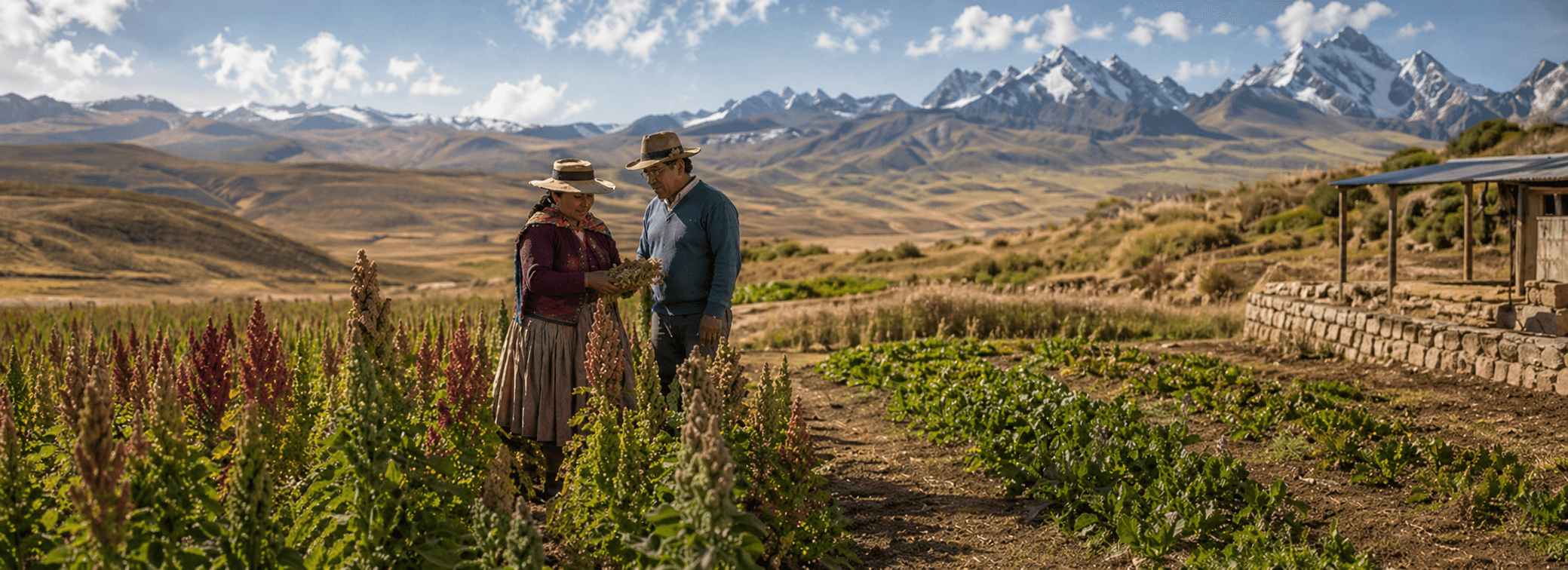
The project «Climate resilience of the quinoa agri-food system» is getting under way. Approved by FONTAGRO’s Board of Directors, it will strengthen organic quinoa production in the highlands of Bolivia and Peru over 42 months. It is led by the Inter-American Institute for Cooperation on Agriculture (IICA), with two co-executors: Bolivia’s National Institute for Agricultural and Forestry Innovation (INIAF) and Peru’s National Institute for Agrarian Innovation (INIA). Associated institutions include the Universidad Mayor de San Andrés (UMSA), the Universidad Pública de El Alto (UPEA), the Universidad Nacional Agraria La Molina (UNALM), the Universidad Nacional del Altiplano in Puno (UNA) and Argentina’s National Institute of Agricultural Technology (INTA).
The approach turns a challenge into an opportunity: manure from sheep, camelids and cattle will be transformed through controlled anaerobic digestion into solid and liquid bioinputs, applied to the soil and to quinoa leaves. UMSA will contribute its biodigesters in Choquenaira and equipment to measure emissions. Its main goals are:
raise organic quinoa yields from an average of 603 kg/ha to about 1,100 kg/ha;
increase soil organic matter by 0.8% and reduce wind erosion by up to 35%;
cut methane emissions from manure by up to 80%;
train more than 2,100 producers from two organic quinoa organizations, one in each country, with at least 30% women and youth;
leave a regional emissions baseline, a protocol to measure them in quinoa and a digital platform to share what is learned.
🔗 Project page (in Spanish) · 🔗 Impact story (in Spanish) · 📄 FONTAGRO TECH (in Spanish) · 📄 Project document (in Spanish)