 Impact
 Initiatives
 Dashboard
 Alliances

 Impact
 Initiatives
 Dashboard
 Alliances

 Technological-Organizational-Institutional
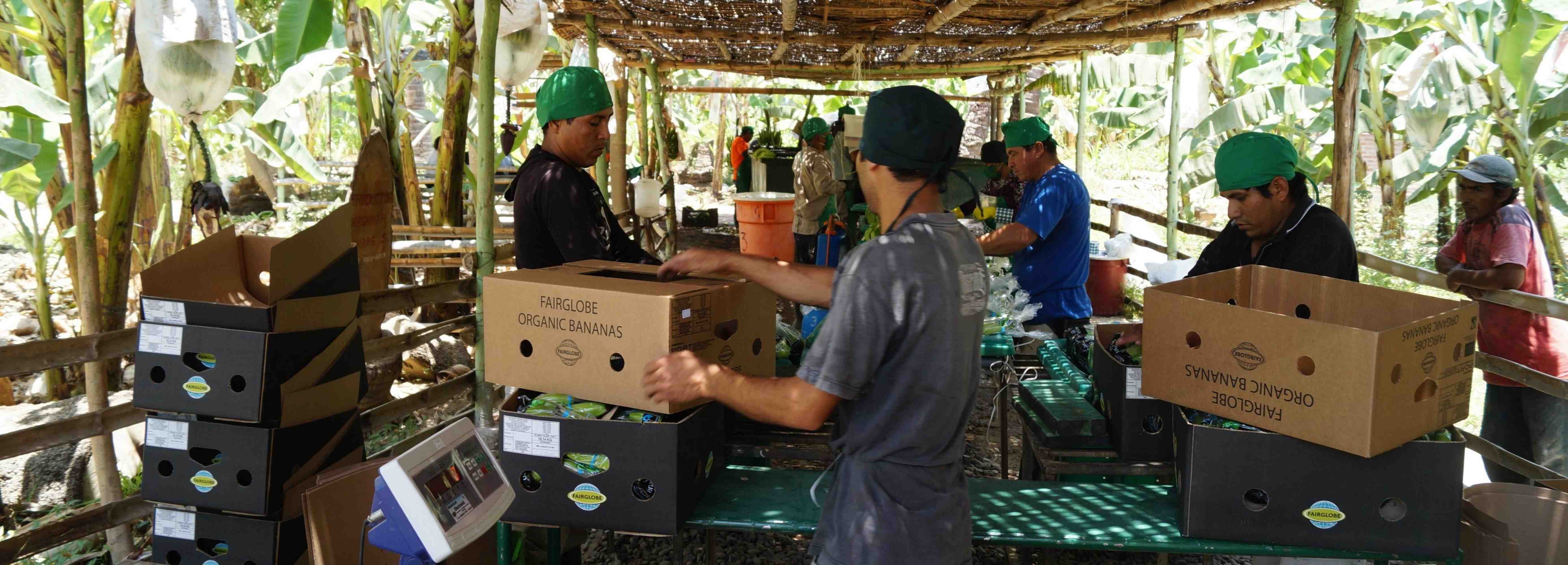
The project “Scaling Up Continuous Improvement in Family Organic Banana Production”, funded by FONTAGRO, is now underway. This proposal, selected under the 2018 call for proposals, aims to help 2,400 producers in the Dominican Republic, Peru, and Ecuador increase export production by 500 boxes per hectare per year.
This can be achieved by improving crop conditions and reducing losses caused, among other factors, by thrips, the insect responsible for red rust blemish (TMR). In addition, the project will focus on soil health and the use of ApsMto capture and transmit counts to data systems that generate outputs on the phytosanitary and productive status of plantations.
Producers are being supported by 15 organizations and three research institutes through technical assistance programs tailored to the conditions of each farm, using comparative indicators to track productive progress and improve compliance with certification standards.
Initial actions
To launch the project activities, an inaugural meeting will be held in each of the participating countries (Peru, Ecuador, and the Dominican Republic) with delegations from up to 10 producer organizations, in order to present the project’s approach. Workshops will also be organized to introduce the technical assistance program, the pilot and broad-scale scaling-up process, and the monitoring plan implemented through the platform.
In addition, looking ahead to 2020, meetings will be held with representatives of the MusaLAC Network (Latin American and Caribbean Network for Research and Development on Musaceae), and the project will participate in the symposium organized by the network through the presentation of posters on producer, technician, and association diagnostics.
Why this project is important
Organic banana production supports more than 10,000 families across over 30,000 hectares in rural communities in the Dominican Republic, Peru, and Ecuador. This crop generates income and provides employment for both family and local labor. Even so, producers are under pressure from pest outbreaks, costly inputs, certification requirements, and extreme climate events. Between 2011 and 2013, organic banana producers in Ecuador and Peru suffered high losses due to red rust blemish (20–30%), a cosmetic defect that nonetheless has zero tolerance in export markets.
Background
The current project builds on a previous FONTAGRO-funded initiative: “Organic Banana (Bioversity, Costa Rica)”, carried out between 2014 and 2018. Under that initiative, improved management based on bagging at the closed bell stage reduced damage to 0–5%, compared with losses of more than 40% in plantations without bagging. In terms of soil health, it was identified that the placement of the harvested plant’s pseudostem and fertilizers in relation to the follower sucker created an area of intense biological activity and root production, thereby increasing yields. These and other results encouraged the participating organizations to continue the research and develop a new proposal to deepen improvements and innovations in family organic banana production for export.