



 Impact
 Initiatives
 Dashboard
 Partnerships

 Impact
 Initiatives
 Dashboard
 Partnerships
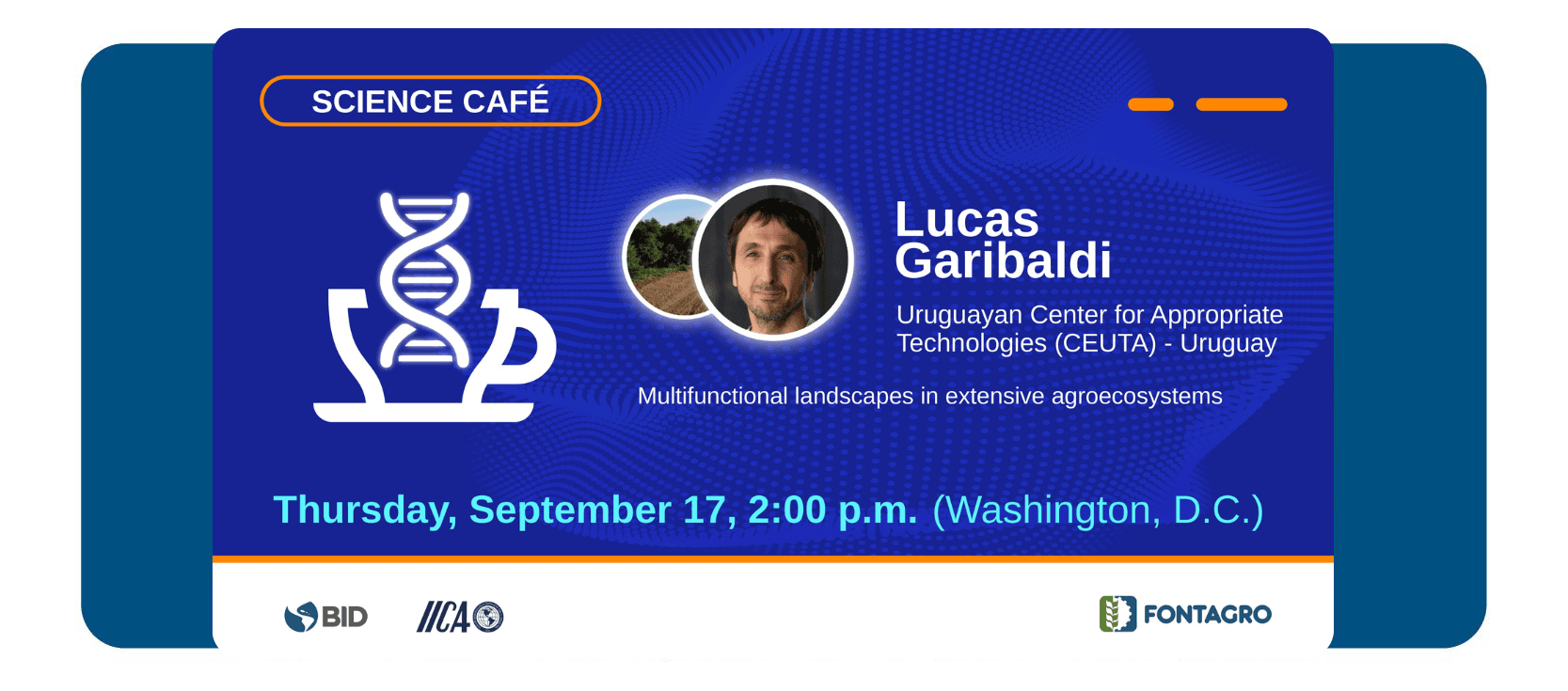
The link between biodiversity and agricultural productivity was the focus of a new edition of FONTAGRO’s Science Café. Lucas Garibaldi, a researcher with the National University of Río Negro and Argentina’s National Scientific and Technical Research Council (CONICET), and leader of the project “Multifunctional landscapes in extensive agroecosystems,” presented progress on the initiative, which is being carried out in Argentina and Uruguay.
Garibaldi explained that the project aims to show that conserving natural or semi-natural habitats and diversifying the landscape help sustain ecosystem services that benefit crops: higher yields, less reliance on agrochemicals, and fewer pests, weeds, and greenhouse gas emissions. To that end, the project designs, implements, and evaluates multifunctional landscapes that include wildlife corridors and service crops.
So far, the team has processed 285 yield maps—nearly three times the original target—and built a geospatial database with more than 4 million records. By combining these data with landscape metrics, satellite imagery, and machine learning models, the team was able to explain more than 80% of the variation in soybean yields. In the field, researchers collected 16,000 insects, and preliminary analyses point to greater diversity of pollinators and natural pest enemies.
During the session, Garibaldi also presented Eirú, a technology for measuring biodiversity that opens up new ways to generate evidence on the health of agroecosystems and to support decision-making on farms.
The project establishes a binational network linking the Uruguayan Center for Appropriate Technologies (CEUTA) with the National University of Río Negro and the South American Institute for Resilience and Sustainability Studies (SARAS).