



 Impact
 Initiatives
 Dashboard
 Alliances

 Impact
 Initiatives
 Dashboard
 Alliances
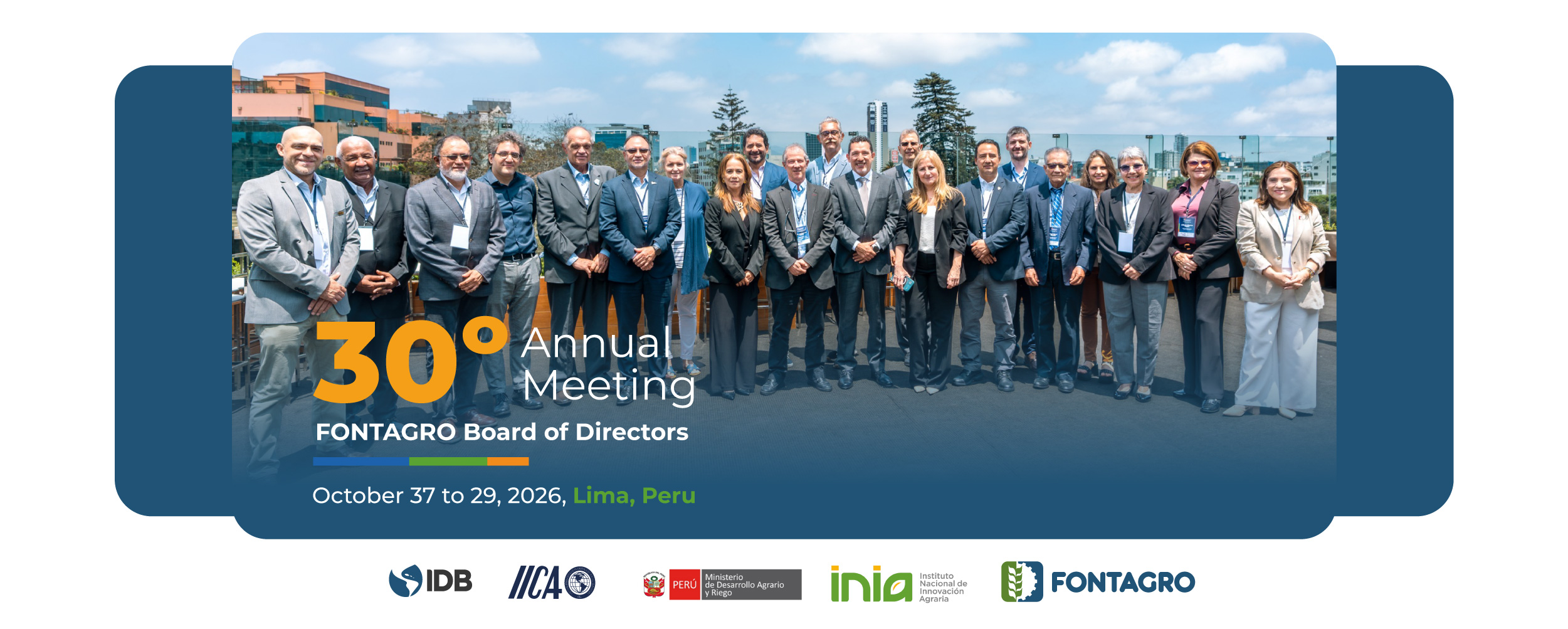
The meeting was organized jointly with the Inter-American Institute for Cooperation on Agriculture (IICA) Delegation in Peru and the National Institute of Agrarian Innovation (INIA – Peru), with the participation of the Inter-American Development Bank (IDB) and IICA, FONTAGRO’s sponsors.
“Agriculture in our region advances further when we work together. Investing in science and innovation means investing in food security, rural development, and better opportunities for our farming families,” said Dr. Christian Barrantes Bravo, President of FONTAGRO and Executive President of INIA – Peru, at the opening session.
The Board reviewed the results of the 2026 Annual Report, discussed the 2027 Annual Operating Plan and the Fund’s partnerships, and explored funding opportunities for new research and innovation initiatives, particularly through the FONTAGRO 2027 Call for Proposals: “FONTAGRO Challenge 2027: Innovation, scaling and AI for the future of agri-food systems in Latin America and the Caribbean.”
During the meeting, Dr. Christian Barrantes and Dr. Miguel Sierra, President of the National Agricultural Research Institute (INIA – Uruguay), signed a memorandum of understanding to collaborate on scientific research, agricultural innovation, technology transfer, and the exchange of experiences. The signing was attended by Dr. Silvana Montes de Oca, Ambassador of Uruguay to Peru.
New Executive Secretary
The Board of Directors elected Jorge Mario Díaz Luengas as FONTAGRO’s new Executive Secretary for the 2027–2029 term. His appointment was the result of a competitive process among several candidates, which concluded with a vote by the representatives of the 15 member countries. Díaz Luengas, who holds a degree in agronomic engineering from the National University of Colombia and a master’s degree in economics from North Carolina State University, served as Executive Director of AGROSAVIA from 2019 to 2025 and represented Colombia on FONTAGRO’s Board of Directors. He will take the helm of the Fund in January 2027.
Peruvian Innovation in the Field
The meeting concluded with a technical tour. At INIA headquarters in La Molina, Dr. Manuel Layseca, Vice Minister of Agrarian Development Policy and Supervision, and Dr. Christian Barrantes presented the Agrarian Innovation Services Network (PRED). With an investment of more than 400 million soles (about US$110 million) and support from the IDB, PRED will provide technology, training, and technical assistance to more than 92,000 producers in six regions to improve their crop and livestock production and their adaptation to climate variability. The delegation toured INIA’s seed, biotechnology, and soil laboratories and visited the International Potato Center (CIP). There, Dr. Tony Salas presented the International Food and Agribusiness Management Association (IFAMA), a global agri-food network that will hold its 37th World Conference in Lima on June 20–25, 2027. The day ended at the Universidad Nacional Agraria La Molina, where participants toured its laboratories and learned about the progress of FONTAGRO projects in which the university participates as a co-executing institution. With its priorities for 2027 set, the 30th Meeting of the Board of Directors reaffirmed a shared message: cooperation among countries is the foundation for more productive, sustainable, and resilient agri-food systems in Latin America, the Caribbean, and Spain.
Eugenia Saini’s Legacy: Fourteen Years of Sowing Innovation Without Borders
Eugenia Saini joined FONTAGRO in 2013, brought on to strengthen project monitoring and follow-up. Drawing on her knowledge and experience in the agricultural sector, administration, and corporate finance, she supported the Fund in improving every area: reducing operating costs, mobilizing more resources, diversifying the portfolio by topic and country, and, above all, expanding its impact in the region. In 2015 she became Fund Administrator and, following an international competition, was appointed Executive Secretary effective January 2018, the first woman to hold the position. At the helm of the Fund, she worked toward a larger, more connected, and more visible FONTAGRO, with a clear roadmap through 2030, and devoted special attention to developing talent. Her leadership put into practice a founding idea: agricultural innovation knows no borders and increasingly requires bringing together scientists and technical experts from different disciplines and countries.
More resources for innovation. Between 2018 and 2026, FONTAGRO approved US$66.6 million for agricultural innovation in the region across 88 operations, several of which were later scaled up by public and private multilateral banks. The Fund’s own contribution was US$15.8 million: for every FONTAGRO dollar, partners and executing institutions added US$3.20, for a total of US$50.8 million mobilized from third parties. Approvals continued every year, even during the pandemic.
A regional network with global reach. All 15 member countries took part in projects during this period, and Saini succeeded in bringing countries with limited participation back into the R&D&I consortia. Each project brings together an average of eight institutions from four countries, for a total of 713 institutional participations. She consolidated partnerships with governments within and outside the region, public and private multilateral banks, the international private sector, CGIAR, FAO, CIRAD, nongovernmental organizations, foundations, and U.S. universities, among many other organizations. She took part in international dialogues with the World Food Prize, AgforClimate, the COPs, and the 1890 Foundation, among many others, and was invited to lecture at universities in the United States and the United Kingdom.
A roadmap to 2030. She coordinated three Medium-Term Plans developed jointly with the member countries. The most recent, for 2025–2030, gave rise to six Flagship Programs, ranging from resilient cropping systems to artificial intelligence. The portfolio already reflects that direction, with 35 projects on resilient and carbon-neutral crops, 17 on livestock systems, and five on the digital revolution, robotics, and artificial intelligence, all implemented by regional R&D&I consortia.
Renewed governance. Saini led and supported the Fund’s corporate transformation: the review of its operating model and institutional documents, and the negotiation and signing, in 2026, of the IDB–IICA–FONTAGRO Tripartite Agreement. Governance was strengthened with three technical committees: the Scientific Committee, the Knowledge Management and Communication Committee, and, most recently, the International Relations and Markets Committee. She also managed two consecutive renewals of the Administration Agreement with the IDB, whose Board of Executive Directors praised FONTAGRO’s results and its visibility and impact in the region.
Digitalization comes to science. Saini developed the digital management system for innovation projects, which allows the outcome indicators of each project to be captured online. Building on that foundation, she set up results monitoring and control dashboards that incorporate artificial intelligence tools. As a result, the Fund continuously tracks the progress of its portfolio and makes data-driven decisions.
Science, talent, and open knowledge. In 2018–2019 she promoted the first study of the economic returns on research funded by FONTAGRO. Projects generate 23.5 Scopus-indexed scientific papers per year, and 387 researchers and technical staff were trained through ten graduate courses. A new bilingual website brings together the Fund’s 227 projects in a dashboard by country, sector, and SDG, which has already been adopted by Argentina’s INTA and Panama’s IDIAP. Completed projects are advancing toward validation and demonstration: 77% of their results are incorporated into the national body of scientific knowledge, 69% reach end beneficiaries, and 74% constitute regional public goods.
A solid Fund. All of this was achieved without new capital contributions from the countries, thanks to the mobilization of resources from other agencies. As of July 2026, the Fund’s investments total US$102.1 million and generate average income of US$4.2 million per year. Today FONTAGRO has 62 projects underway, with an active portfolio of US$14.9 million that reaches US$46.1 million when the counterpart contributions of executing institutions are included.
The seeds she planted. Beyond the numbers, her greatest achievement was consolidating a way of working: countries that conduct research together, share what they learn, and turn science into concrete solutions for producers. As she stated at the Borlaug International Dialogue: “Latin America and the Caribbean is decisive for global food security, and the innovation that this responsibility demands is only possible by working together. When institutions join R&D&I consortia, they generate knowledge more quickly and effectively, and that knowledge is the foundation of productive, sustainable, and resilient agri-food systems.”
This is the FONTAGRO she leaves behind: a solid regional platform with international prestige, ready to keep growing. Thank you, Eugenia, for fourteen years of vision, commitment, and teamwork. Her key words: Passion, Patience, Persistence.