 Impact
 Initiatives
 Dashboard
 Alliances


 Impact
 Initiatives
 Dashboard
 Alliances

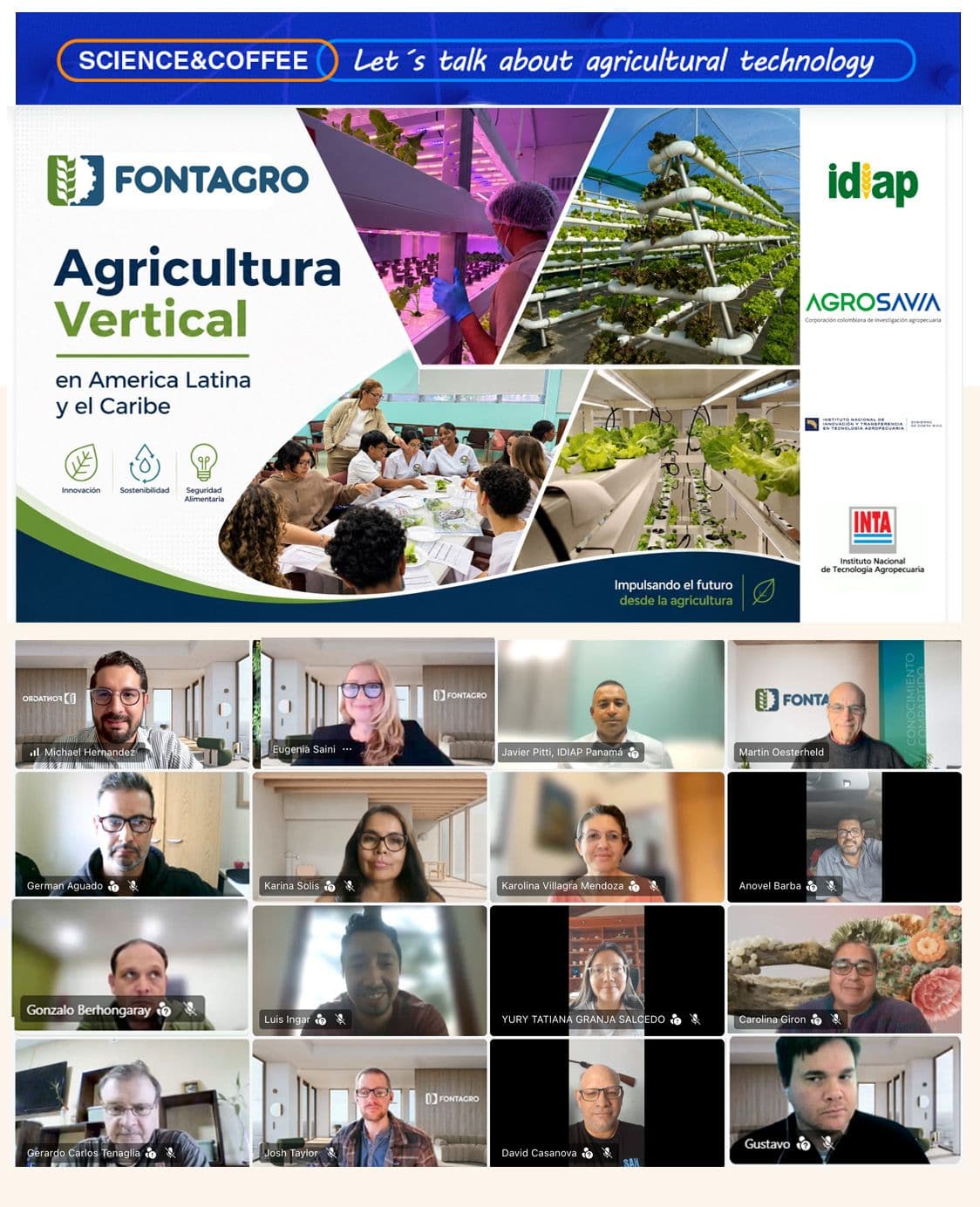
Vertical farming was the focus of a new edition of FONTAGRO’s Science Café. Javier Pitti Caballero, leader of the project “Feasibility of vertical farming technologies in Latin America and the Caribbean,” presented progress on the initiative, which is being carried out in Argentina, Colombia, Costa Rica, and Panama.
The project evaluates vertical farming systems as a sustainable way to produce intensive crops and to support food security, competitiveness, and climate resilience. It is led by the Inter-American Institute for Cooperation on Agriculture (IICA) together with INTA Argentina, AGROSAVIA (Colombia), INTA Costa Rica, and IDIAP (Panama).
Pitti shared key results from each country. In Argentina, indoor vertical systems yielded 14.5 kg of lettuce per square meter (about 3 lb per square foot), compared with 4.6 kg in soil-based growing beds, and needed only 3.8 liters of water per kilogram produced—a water saving of 87.6%. Lettuce grown in these systems also showed 155% higher polyphenol content and 18% greater antioxidant capacity than lettuce from the conventional system.
In Colombia, AGROSAVIA set up an indoor system in a 20-foot shipping container, an indoor growing prototype, and five semi-protected systems, with climate modeling and monitoring of four crops. In Panama, the team evaluated six species in three production systems, and a taste test with nutrition students at the University of Panama showed a preference for lettuce grown in a protected environment; a trial using a lunar regolith simulant was also set up. In Costa Rica, hydroponic towers outperformed NFT systems: for lettuce, yield rose from 2.61 to 4.93 kg/m² and water use efficiency from 9.86 to 16.50 kg/m³.
The project is also assessing the economic and financial feasibility of these systems, mapping key players in the value chain, and building partnerships to form clusters and business models. On the knowledge-sharing front, it has trained more than 850 people in person, and its webinars have drawn thousands of views.
Looking ahead, the team aims to develop and validate biofunctional vegetable production systems in controlled vertical environments geared toward specialty markets.