 Impact
 Initiatives
 Dashboard
 Alliances

 Impact
 Initiatives
 Dashboard
 Alliances
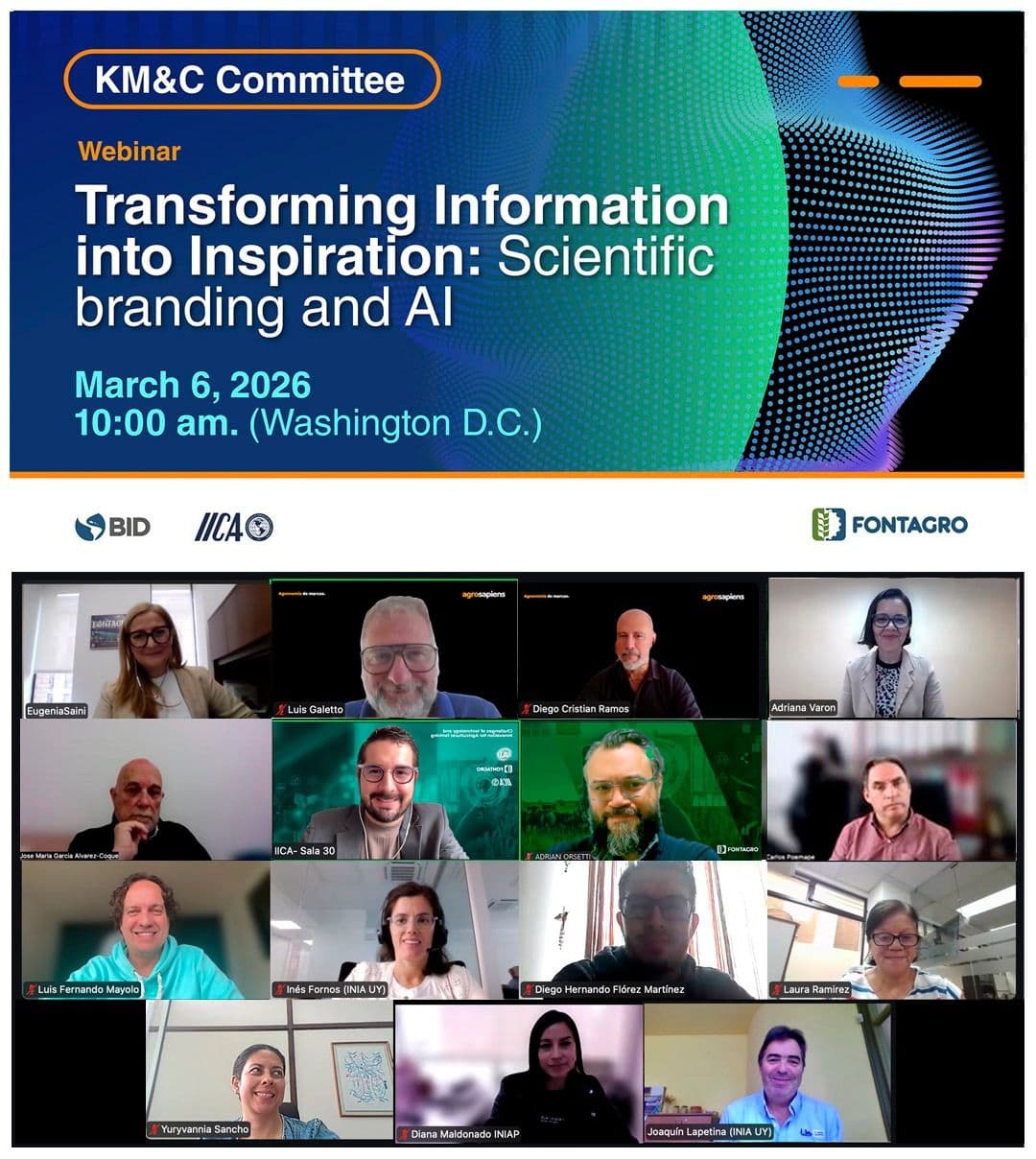
On March 6th, the first meeting of FONTAGRO's Knowledge Management and Communication Committee (KM&C) took place under the theme, "Scientific Branding and AI Tools for Science Communication: Transforming Information into Inspiration." This gathering, led by FONTAGRO's Technical and Administrative Secretariat, brought together over 30 specialists from the KM&C of member national agricultural research institutes and the Inter-American Institute for Cooperation on Agriculture (IICA), alongside prominent experts in science communication from AGROSAPIENS, a strategic communication agency specializing in the agricultural sector, and the Alliance of Bioversity International and CIAT.
During a panel moderated by Eugenia Saini, Executive Secretary of FONTAGRO, innovative strategies for communicating science and enhancing the promotion of research, development, and innovation (R&D+i) in food systems across Latin America and the Caribbean (LAC) were discussed. Among the highlighted interventions:
- 🔹 Luis Galetto and Diego Cristian Ramos, Director and Creative Consultant of AGROSAPIENS, respectively, presented “Science That Doesn’t Connect Doesn’t Exist: Strategies for Capturing Attention in 2026.” Their presentations explored how branding tools and strategic communication can strengthen the link between science and digital communities. They emphasized the importance of adopting an approach that amplifies real-life experiences, particularly in a context of saturation and digital fatigue. They stressed the need to generate meaningful content that genuinely impacts interested audiences. Through examples and success stories, they highlighted that scientific content, although sometimes dense and lengthy, possesses the great strength of credibility. The real challenge lies in making it not only relevant but also captivating. Telling stories that incorporate the human aspect of science is essential to resonate with audiences. They suggested that each organization dedicated to science should become a true brand platform by defining a clear purpose, identifying priority audiences, establishing an authentic tone of voice, and differentiating its value proposition within its communication territory. They concluded that “science that doesn’t connect is invisible, but the science that does transforms production systems, attracts investment, and inspires the next generation of scientists and producers.”
- 🔹 Adriana Varón, Communications Specialist for the Americas at the Bioversity & CIAT Alliance, delivered a presentation focused on "Why and What for Communicating Science?" In her talk, she highlighted the fundamental value of testimonials and narratives in disseminating scientific knowledge, emphasizing that science in Latin America and the Caribbean addresses key challenges, produces relevant knowledge for the world, and has a direct impact on the territory. She explained that communicating science is not merely about appearing in media, filling social media channels, or meeting indicators. “Instead, it’s about building trust, influencing public policy, combating misinformation, and building institutional reputation.” To this end, she identified five pillars of strategic communication: communication must be present throughout the entire project life cycle, the message must take precedence over the format, scientific spokespersons must be prepared, institutional narratives must be coherent, and it is essential to measure the influence of communicational impact. "If science needs bridges... we know how to build them," Adriana concluded.
The meeting not only fostered an enriching dialogue between panelists and attendees but also created a space to discuss significant topics in scientific communication. Among these was the importance of establishing strategic relationships with international media and the private sector to highlight and leverage technologies and innovations developed by the different national agricultural research institutes. Future meeting topics also included communication strategies during crises.
The event concluded with a renewed commitment to collaboration among KM&C Committee members, focused on strengthening communication efforts and expanding the reach of scientific knowledge in the region.
We extend our gratitude to all participants and those who made this event possible, which marks a significant step in consolidating knowledge networks within the agro-food sector of the region.