



 Impact
 Initiatives
 Dashboard
 Alliances

 Impact
 Initiatives
 Dashboard
 Alliances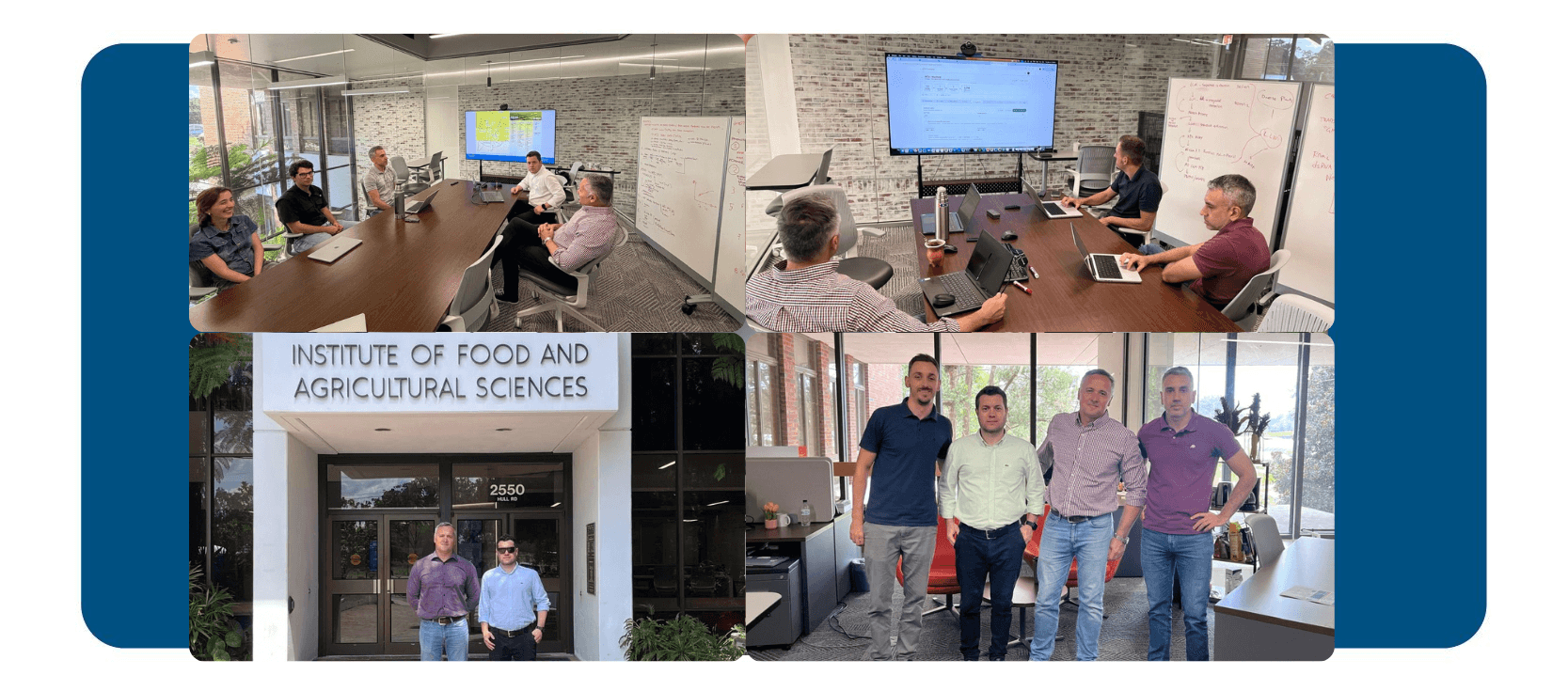
A technical mission from the RECSO-Americas project collaborated with the University of Florida’s Crop Transformation Center (UF/IFAS) to calibrate simulation models. These models will assist producers in five countries in deciding what, when, and how to plant soybeans.
Cristian Vissani, leader of the RECSO-Americas project, and team member Marcos Murgio, both researchers from Argentina’s INTA, conducted a technical visit to the University of Florida’s Crop Transformation Center (UF/IFAS). The goal was to strengthen scientific cooperation between the two institutions and advance the development of tools to support decision-making in soybean production.
The mission is part of the project "Regional Network for Cultivar Evaluation, Yield Gap Reduction, and Innovation Transfer (RECSO-Americas)." This project is co-financed by FONTAGRO and executed by the National Institute of Agricultural Technology (INTA – Argentina), the Colombian Corporation for Agricultural Research (AGROSAVIA), the National Institute of Agricultural Research (INIA – Uruguay), the National Institute of Agricultural Innovation (INIA – Peru), and the Paraguayan Institute of Agricultural Technology (IPTA). Partners include the Argentine Seed Association (ASA), Uruguay’s National Seed Institute (INASE), Corteva Agriscience, and the University of Florida.
During the visit, Vissani and Murgio worked with the UF/IFAS team, led by Crop Transformation Center Director Carlos Messina and including researchers Ignacio Hisse and Gustavo Visentini, to analyze historical data from the Soybean Cultivar Evaluation Network (RECSO), which compiles information from cultivar evaluation trials. Building on this foundation, progress was made in calibrating and validating the DSSAT CROPGRO-Soybean simulation model for various maturity groups, utilizing the GEM interface developed by the University of Florida team.
This work will enhance the models' ability to evaluate management alternatives across different environments, focusing on the selection of planting dates, maturity groups, and cultivars. The approach incorporates a probabilistic assessment of decisions made under climate uncertainty a critical factor in the production systems where RECSO-Americas operates.
The teams agreed on a joint work plan to delve deeper into the study of genotype-environment-management interactions; estimate genetic gain; redefine mega-environments; and analyze the relationships between yield, oil content, and protein content. Future project steps include generating environment-specific management recommendations and developing a digital platform to integrate RECSO-Americas data. The initiative will involve data and teams from Argentina, Uruguay, Paraguay, Peru, and Colombia, aiming to facilitate the transfer of tools to producers and advisors.
This visit aligns with one of the project's core components and strengthens technical and scientific cooperation between the network's national teams and the University of Florida. This collaboration will enable the information generated in regional trials to be translated into concrete recommendations for soybean producers and advisors across the Americas.
"At FONTAGRO, we seek to promote a vision of cooperation that increasingly connects scientific and technological institutions across the Western Hemisphere around shared goals," noted Eugenia Saini, Executive Secretary of FONTAGRO. “Linking the capabilities of Latin America and the Caribbean with universities and centers of excellence in the United States and other countries allows us to complement knowledge, infrastructure, and talent; strengthen the capabilities of our researchers; and accelerate the development and transfer of innovations to producers. This project is a concrete example of the type of long-term scientific partnerships we need to foster in order to jointly address the challenges facing agriculture in the Americas.”