 Impact
 Initiatives
 Dashboard
 Alliances


 Impact
 Initiatives
 Dashboard
 Alliances

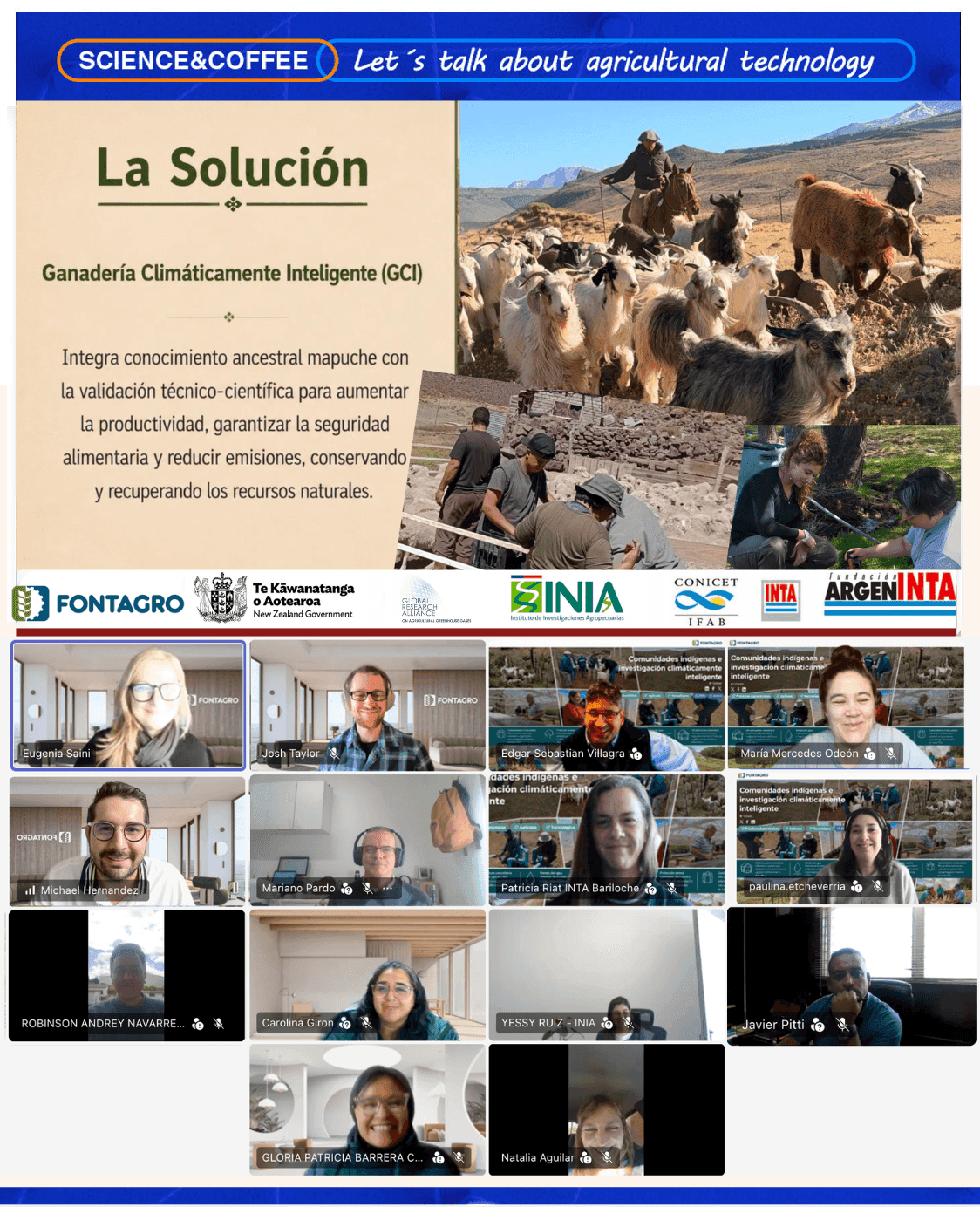
In a new edition of FONTAGRO’s Science Café, Sebastián Villagra, of Argentina’s National Agricultural Technology Institute (INTA) and leader of the project “Climate-smart research and indigenous communities,” showed how climate-smart livestock farming can strengthen the resilience of Mapuche communities in the Patagonia region of Argentina and Chile.
Villagra described a territory with a strong livestock-rearing tradition and rich cultural capital, but with limited access to technology. The project’s response is to combine ancestral Mapuche knowledge with technical and scientific validation to raise productivity, ensure food security, and reduce emissions while conserving natural resources. The work involves five communities in Neuquén and Río Negro (Argentina) and La Araucanía (Chile), and is carried out by INTA, Chile’s Agricultural Research Institute (INIA), and the ArgenINTA Foundation, with Argentina’s National Scientific and Technical Research Council (CONICET) as a partner.
The research combines 15 innovation units on community land, under real-world conditions, with 12 research units under controlled conditions. At INTA Bariloche’s experimental unit, the team is testing low-cost technologies for efficient water use, such as rainwater harvesting and freeze-resistant water troughs, as well as alternative feed sources such as native corn, hydroponic green fodder, and insect meal. In Chile, fencing livestock out of eroded areas in Lonquimay boosted forage production on flat pastures to as much as 2,500 kg of dry matter per hectare (about 2,230 lb per acre).
The project also supports native plant nurseries as spaces for intercultural education and for preserving traditional knowledge. Its results include 50 training sessions with some 5,000 participants, 500 farmers adopting new technologies, 60 women in decision-making roles, five international scientific publications, and a formally established intercultural management team.