



 Impact
 Initiatives
 Dashboard
 Partnerships

 Impact
 Initiatives
 Dashboard
 Partnerships
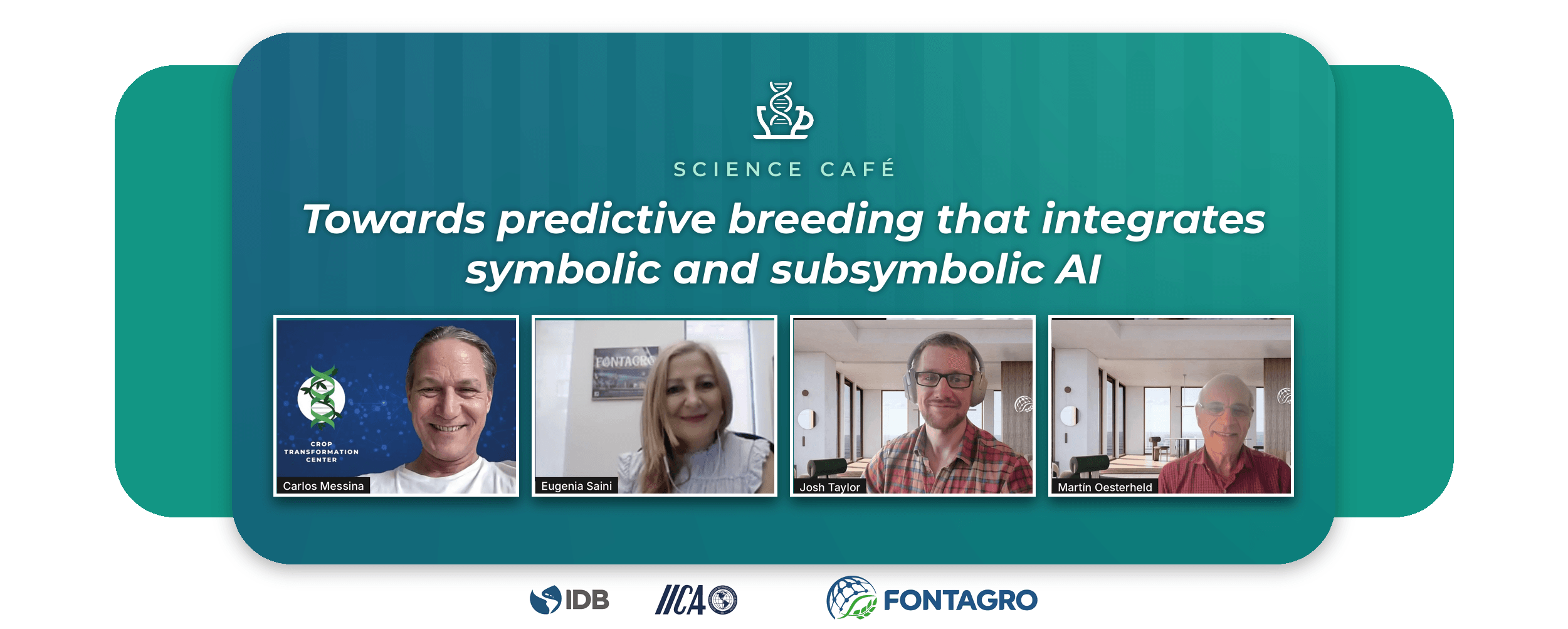
FONTAGRO held a new edition of its Science Café, a space for exchange among the teams of projects funded by the Fund, special guests and international experts. The guest speaker was Dr. Carlos Messina, Professor in the Horticultural Sciences Department and Director of the UF/IFAS Crop Transformation Center at the University of Florida, who has extensive experience at Pioneer/DuPont and Corteva Agriscience. The session was moderated by Dr. Martín Oesterheld, Scientific Operations Specialist at FONTAGRO, with the participation of Dr. Eugenia Saini, Executive Secretary, and Dr. Joshua Taylor, Senior Programs and Operations Specialist.
During his presentation, Messina explained that artificial intelligence (AI) can extend prediction tools, which are currently concentrated in major crops such as maize and soybean, to more crops and breeding programs. In this way, public programs and orphan crops could gain diversity, adaptation and resilience.
The key, according to Messina, lies in combining two approaches: symbolic AI, which incorporates physiological knowledge into crop simulation models, and subsymbolic AI, which learns patterns from data. Using maize trials in drought-prone environments in the United States, he showed that adding a simulation model to genomic prediction improves accuracy, especially in the most complex environments.
“This combination is not one or the other, but both, which should be capturing different parts of the genetic variance,” said Messina.
Along these lines, he stressed that scientific knowledge reduces the amount of data AI needs to learn, and proposed moving from sampling environments to designing experiments to train it. This methodology, developed with Corteva data on sorghum, is already being extended to sorghum breeding in West Africa. “AI allows us to democratize the use of symbolic and subsymbolic AI, which about five years ago only multinationals could use,” he noted.
During the exchange with the audience, Messina answered questions about crops with less data, such as quinoa and beans, and about applying these models to fruit trees and diseases. Referring to FONTAGRO's potential, he highlighted that it is a network that brings together the national research systems of Latin America and the Caribbean around crops such as sorghum, soybean and sweet potato. In his view, this collaboration, and its possible evolution into multi-crop networks, offers the diversity of environments, production systems and crops needed to train more robust and transferable AI models.
We invite the community to stay tuned for upcoming FONTAGRO events.
Watch the full recording of this event: