



 Impact
 Initiatives
 Dashboard
 Partnerships

 Impact
 Initiatives
 Dashboard
 Partnerships
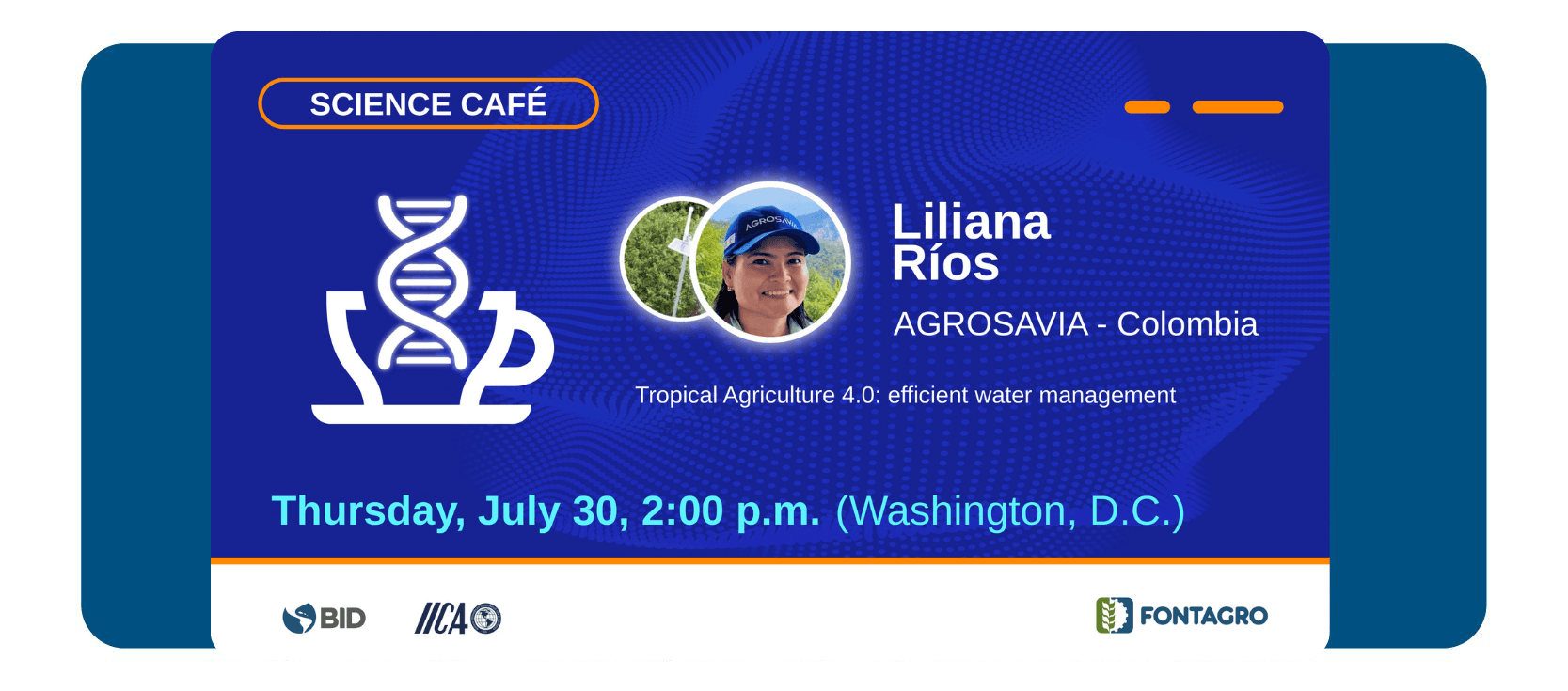
FONTAGRO’s Science Café devoted a new session to the efficient use of irrigation water. Liliana Ríos, PhD. researcher of the Colombian Agricultural Research Corporation (AGROSAVIA), presented progress on the Agriculture 4.0 rollout of the project “Tropical Agriculture 4.0: efficient water management”, which is being carried out in Colombia, Ecuador, and Honduras.
The project starts from a simple question for farmers: when, and how much, should they irrigate? To answer it, the team installed 36 monitoring points in avocado, cacao, Tahiti lime, and papaya crops. An initial assessment based on surveys and on-site flow measurements found that only 14% of farmers intended to adopt digital technologies; the rest considered them too expensive.
Ríos explained how the team built an IoT network that tracks the soil-plant-atmosphere system in real time using soil moisture sensors, fruit dendrometers, and weather stations. The data feed a web platform that replaced the original spreadsheet. An algorithm calculates each plot’s field capacity, sets an optimal irrigation range, and displays current moisture levels. Farmers and technicians can check any station by scanning a QR code and irrigate based on the plot’s actual moisture rather than a fixed calendar.
For farmers who are not connected to the network, the 2025–2026 historical data made it possible to build crop-specific irrigation schedules. In cacao, for example, irrigation frequency went from every 5 days to every 11 days; in papaya, it went from daily watering to 30 minutes every 3 days.
The results are striking. Compared with calendar-based irrigation, sensor- and weather-based irrigation cut water use by 30% in avocado, 28% in cacao, and 92% in papaya. Overall, the technology saved 30% in water, 30% in labor, 29% in fuel, and 30% in operating costs, while irrigation water use efficiency rose from 1.9% to 25.5%.
The initiative brings together an AgTech ecosystem that includes AGROSAVIA, the University or Zamorano - Honduras, the Technical University of Manabí - Ecuador, Visualiti, and ASORUT - Colombia. According to Ríos, this digital environment is open to any country, crop, or network that wishes to join.