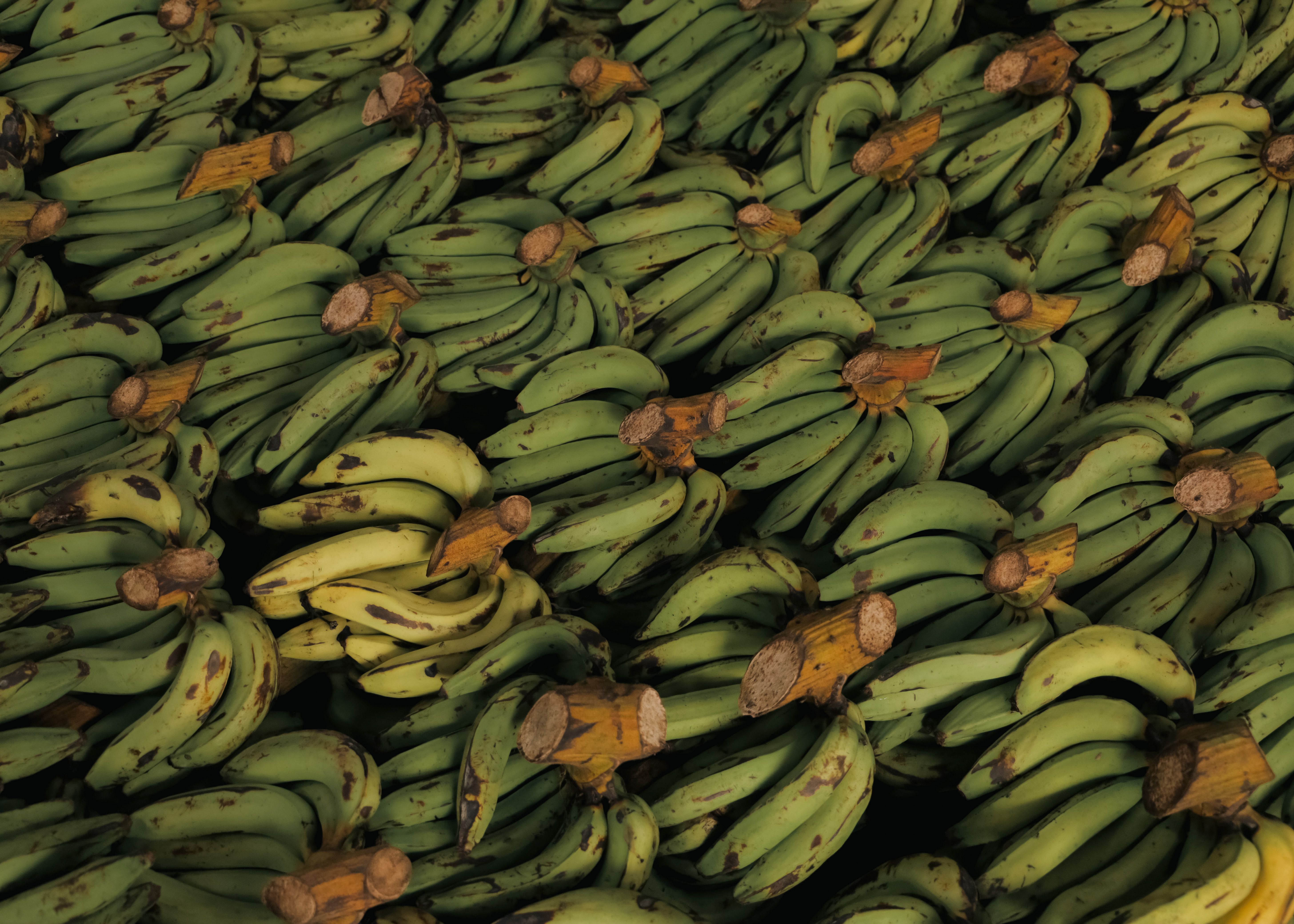
Latin America grows 80% of the world's export bananas. Five countries are testing rapid diagnostics, biological control, and tolerant varieties to live with vascular diseases and slow their advance.

In La Guajira and Magdalena, twenty banana farms live alongside a fungus that does not leave: more than 4,000 hectares are under quarantine and some 200 have been eradicated. In Piura, 45% of organic banana growers are already affected and one farm in ten has been devastated; net present value per hectare falls from $48,014 to $8,535 once the disease arrives. The culprit, Fusarium oxysporum f. sp. cubense tropical race 4 (Foc R4T), invades the plant's xylem, survives in the soil for decades through resting structures, and can wipe out an entire field. Since 2019 it has been reported in turn in Colombia, Peru, Venezuela, and Ecuador, in a region that grows 80% of the world's export bananas.
Five countries, four diseases, and a network that has worked together before
The initiative scales up, in Colombia, Ecuador, Peru, Spain, and Venezuela, the results of an earlier phase that between 2021 and 2026 validated diagnostic protocols, screened more than 40 biological control agents, and trained over 13,000 people across ten countries. The work is now organized around risk management: containing what is already present, Foc R4T and bacterial Moko, and preparing for what has not yet arrived, banana bunchy top virus and banana blood disease. Trials are set up on working farms, with designs matched to each country's phytosanitary and regulatory situation, and they extend to the Canary Islands, which face the same pressures.

When a plant wilts in the field, the grower does not know what killed it until a central laboratory confirms it, and in that interval the pathogen keeps advancing. The project moves diagnosis into the field: molecular protocols validated across countries for Foc R4T and its races, Moko, banana blood disease, and the bunchy top and streak viruses, with rapid methods applied to the suspect plant itself and a regional bank of positive DNA controls that does not yet exist in the region. Once an outbreak is confirmed, characterized strains of Trichoderma spp. and Bacillus spp. come in, produced in local units and applied alongside soil amendments, organic matter, biochar, and cover crops. To plant again where the pathogen remains, promising clones are assessed in the field for tolerance to Foc R4T, along with lines obtained through induced mutation, backed by low-cost clean seed multiplication nuclei. And where connectivity is limited, an educational WhatsApp chatbot delivers the short courses.
 Integrated Pest ManagementResilient Crops and Carbon Neutrality (“PI-1”)AppliedTechnologicalCropsGenetic improvementBio-inputsPests y Diseases
Diagnostic protocols harmonized across countries for five groups of banana pathogens, including methods applied directly in the field that do not yet exist anywhere in Latin America and the Caribbean, should become available together with a regional bank of positive DNA controls verified through an interlaboratory trial. On an outbreak already declared, eight integrated management recommendations for Foc R4T and Moko come into play, drawn from semi-commercial trials of 6 to 20 hectares in Colombia, Peru, and Venezuela followed over at least three production cycles, plus two local bioinput production units in Ecuador and Peru. To produce again where the pathogen remains, the project plans to assess at least five promising clones in the field, select two induced-mutation lines, and install two clean seed nuclei in Peru and Venezuela. The ex ante estimate places the benefit at a 40% to 60% reduction in plant mortality in affected areas and savings of close to 25% on agrochemicals.



Sede Central
Colombia

Ecuador

Perú

Venezuela


 Impact
 Initiatives
 Dashboard
 Alliances
 Impact
 Initiatives
 Dashboard
 Alliances



.png&w=640&q=75)