



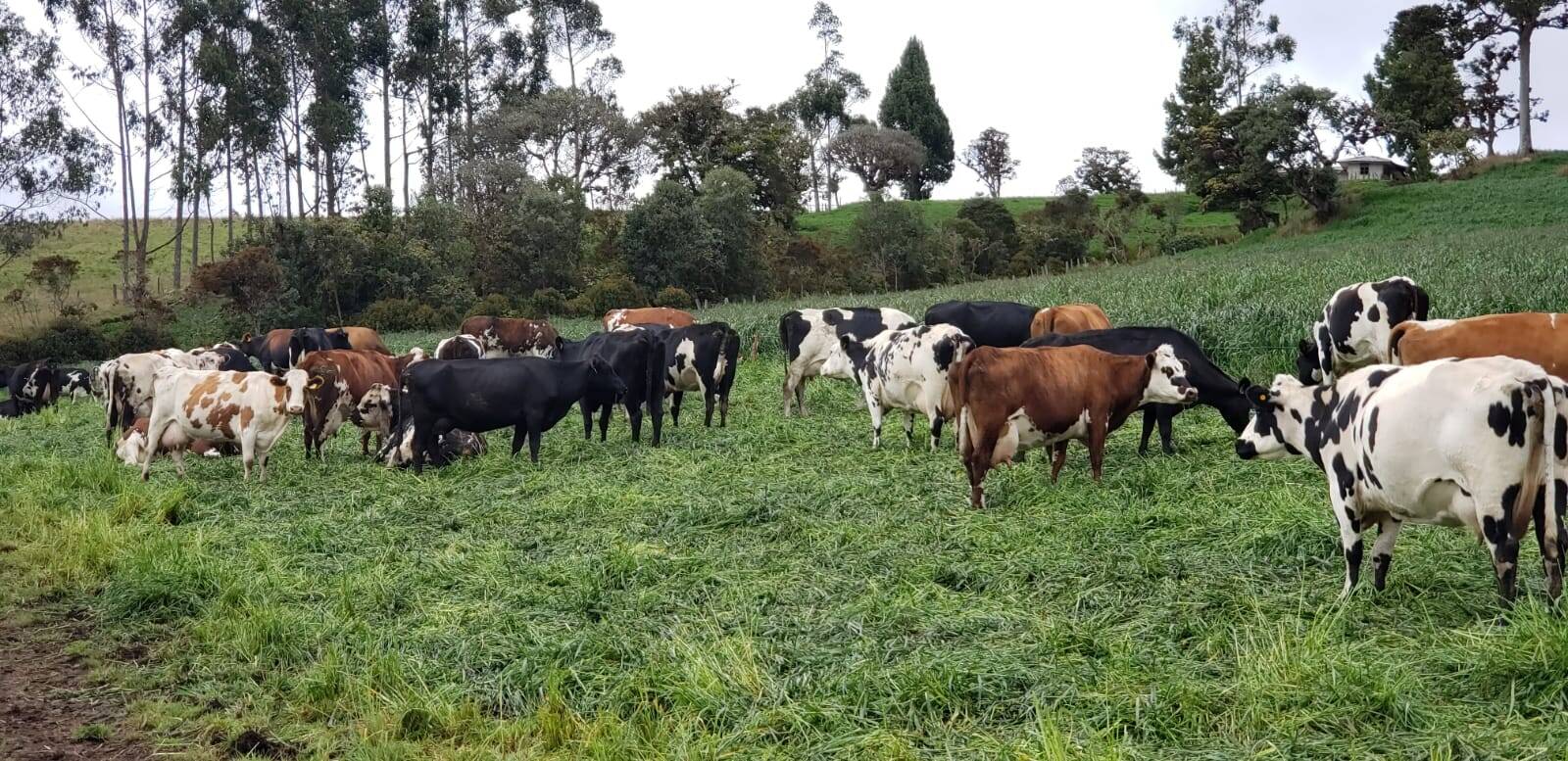
This project eco-efficiently improves tropical dairy productivity in Colombia and Ecuador. By implementing climate-smart strategies and utilizing local forages, it reduces carbon emissions, boosts yields by 20%, and ensures food security.

In Cauca (Colombia) and Manabí (Ecuador), smallholder dairy systems show low productivity and efficiency due to their high dependence on pastures affected by climate variability, which reduces forage availability and quality, increases supplementation costs, and limits profitability. This situation is compounded by technological gaps, scarce information on environmental impacts, and limited adoption of sustainable practices. As a result, milk production, sector competitiveness, and regional food security are all at risk. Therefore, climate-smart strategies are needed to support a transition toward eco-efficient, resilient, and sustainable dairy systems.
Boosting climate resilience and profitability through smart bovine nutrition and environmental management in dairy systems in Cauca and Manabí
The project aims to increase the productivity of dairy systems in Cauca (Colombia) and Manabí (Ecuador) through climate-smart production strategies. Its objectives are: 1) to characterize the productivity and nutritional profile of feed sources; 2) to determine the environmental parameters of dairy systems; 3) to develop sustainable cattle feeding strategies that improve productive efficiency and reduce environmental impacts; and 4) to strengthen knowledge appropriation and close technological gaps through technical assistance and technology transfer to producers and communities

The proposed solution consists of implementing climate-smart production strategies to transform traditional dairy systems in Cauca (Colombia) and Manabí (Ecuador) into more eco-efficient, resilient, and sustainable models. To achieve this, a comprehensive assessment will be carried out on productivity, forage availability, and the nutritional profile of feed sources, together with the measurement of environmental parameters in dairy systems. Based on this information, sustainable cattle feeding strategies will be designed and validated to improve productive efficiency, optimize the use of pastures and inputs, reduce costs, and decrease environmental impacts. In addition, the solution includes technical assistance, technology transfer, and social appropriation of knowledge processes to strengthen capacities, close technological gaps, and facilitate the adoption of sustainable practices by producers and communities.

"The best way to contribute to food security in Latin America and the Caribbean (LAC) is by “çtransforming its agrifood systems to make them more efficient, inclusive, resilient, and sustainable."— FAO, 2022
 Agronomic PracticesAppliedTechnological
It is expected that the productivity of the dairy farms intervened in Cauca and Manabí will increase by at least 20%, measured in liters of milk per hectare per year, through the implementation of climate-smart production strategies. Likewise, a nutritional, productive, and environmental characterization of traditional and eco-efficient dairy systems will be obtained, which will serve as a baseline for decision-making. Sustainable cattle feeding strategies are also expected to be validated in order to improve productive efficiency, reduce costs, and decrease environmental impacts. Additionally, the capacities of producers and stakeholders in the agricultural sector will be strengthened through technical assistance, technology transfer, and the use of ICTs, promoting the adoption of sustainable practices, greater climate resilience, and an effective contribution to regional food security.
Relevant data







Ecuador
Colombia

Colombia

Ecuador

The Tangible Impact of Science and Technology in the Field

 Impact
 Initiatives
 Dashboard
 Alliances
 Impact
 Initiatives
 Dashboard
 Alliances





.png&w=750&q=75)