



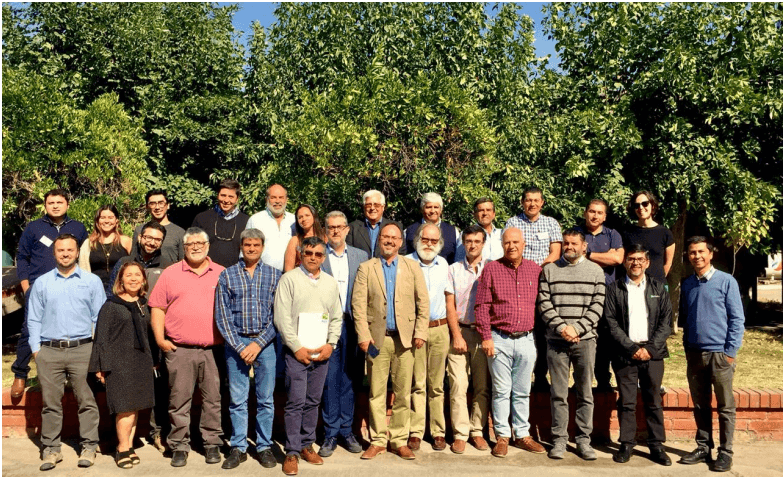
In March 2019, irrigation researchers from Chile, Argentina, Uruguay and Spain met technology companies in Santiago to define what the region's agriculture needs and how to get it to the end user.

Agriculture accounted for 70 % of the world's water withdrawals and 93 % of its consumption in 2000, and total water demand is projected to rise 55 % by 2050, with food production up 60 %. Latin America and the Caribbean reaches that horizon in an unusual position: with sub-Saharan Africa it is one of only two regions able to expand its irrigated area sustainably, and its irrigable surface almost tripled between 1960 and 2015, from 12 to 31 million hectares. The problem is efficiency. Irrigation in the region operates at around 25 % overall efficiency, so small improvements translate into considerable gains.
The technology exists; the gap is reaching the grower
The initiative grew out of the sixteenth meeting of the Ibero-American INIA system, held in La Serena in October 2017, where the institutions agreed to create a dedicated working group on water for agriculture. The seed fund turned that mandate into a technical workshop at INIA La Platina, Santiago de Chile, from 20 to 22 March 2019. Eleven presentations set out concrete experience in using new technologies for irrigation management, from research institutes and universities as well as technology suppliers, detailing the strengths and weaknesses of each tool. That material was used to build a matrix of technological gaps and solutions.

The platform agreed seven categories of technological tools: defining crop irrigation requirements; monitoring crop development; monitoring internal crop water status; monitoring water availability in the soil; modelling the soil water balance; modelling water supply and demand at regional scale; and recording and controlling water at regional and farm scale. What distinguishes them is that they span linked scales, from water potential measured in a single plant with a pressure chamber or dendrometer to telemetric gate control across a whole basin. The workshop showed both ends in operation: Chile's satellite agricultural platform, which tracks crop development through the NDVI index, and the telemetric gates of the Elqui River water users' association.
 Agronomic PracticesSustainable intensificationAdaptativeTechnological-Organizational-InstitutionalNatural resourcesFamily agricultureAgricultural systems
The seed fund closed with the Water Management in Agriculture 2030-2050 Platform established and an agreed project defined for submission to FONTAGRO. The seven families of technologies were settled, along with the two working scales, basin and on-farm irrigation, and the selection criteria: actual crop water requirements, water supply, agronomic water productivity, water quality and distribution, and decision strategies based on the information generated. The project provides for technological pilots in seven agricultural regions across five countries: Coquimbo and Ñuble in Chile, Mendoza and Córdoba in Argentina, the Cauca valley in Colombia, Salto in Uruguay and the Ebro basin in Spain.



Chile
España

España

Argentina

Argentina

The Tangible Impact of Science and Technology in the Field

 Impact
 Initiatives
 Dashboard
 Alliances
 Impact
 Initiatives
 Dashboard
 Alliances









.jpg&w=640&q=75)

.png&w=750&q=75)
