A regional effort to develop, validate and disseminate biologicals that raise productivity and reduce dependence on agrochemicals in strategic crops across Costa Rica, Honduras, Panama and Venezuela.

Rising input costs, with fertilizer prices climbing 200% between April 2020 and March 2022, together with climate variability that intensifies pests and diseases, are straining the sustainability of production systems. Biologicals, products derived from living organisms, are a growing alternative: the market is expanding by up to 17% a year and the region holds 29% of the global market. Yet their adoption remains limited. Biofertilizer development is still incipient, many technologies stay at early stages without rigorous scientific validation, and uncertainty persists around their efficacy, the right doses and the economic benefits of their use.
Regional research to take biologicals from the laboratory to the field.
The project aims to increase the availability of biological technologies that improve the sustainability of agricultural production in the region. It is built around four objectives: standardizing quality by harmonizing quality-control protocols; developing biologicals to commercial application level by accompanying the experimentation process; integrating these technologies into management schemes for strategic crops such as maize, sweet pepper, bean and citrus; and promoting their efficient use through knowledge management and a regional cooperative virtual space. The work is carried out jointly across Costa Rica, Honduras, Panama and Venezuela.

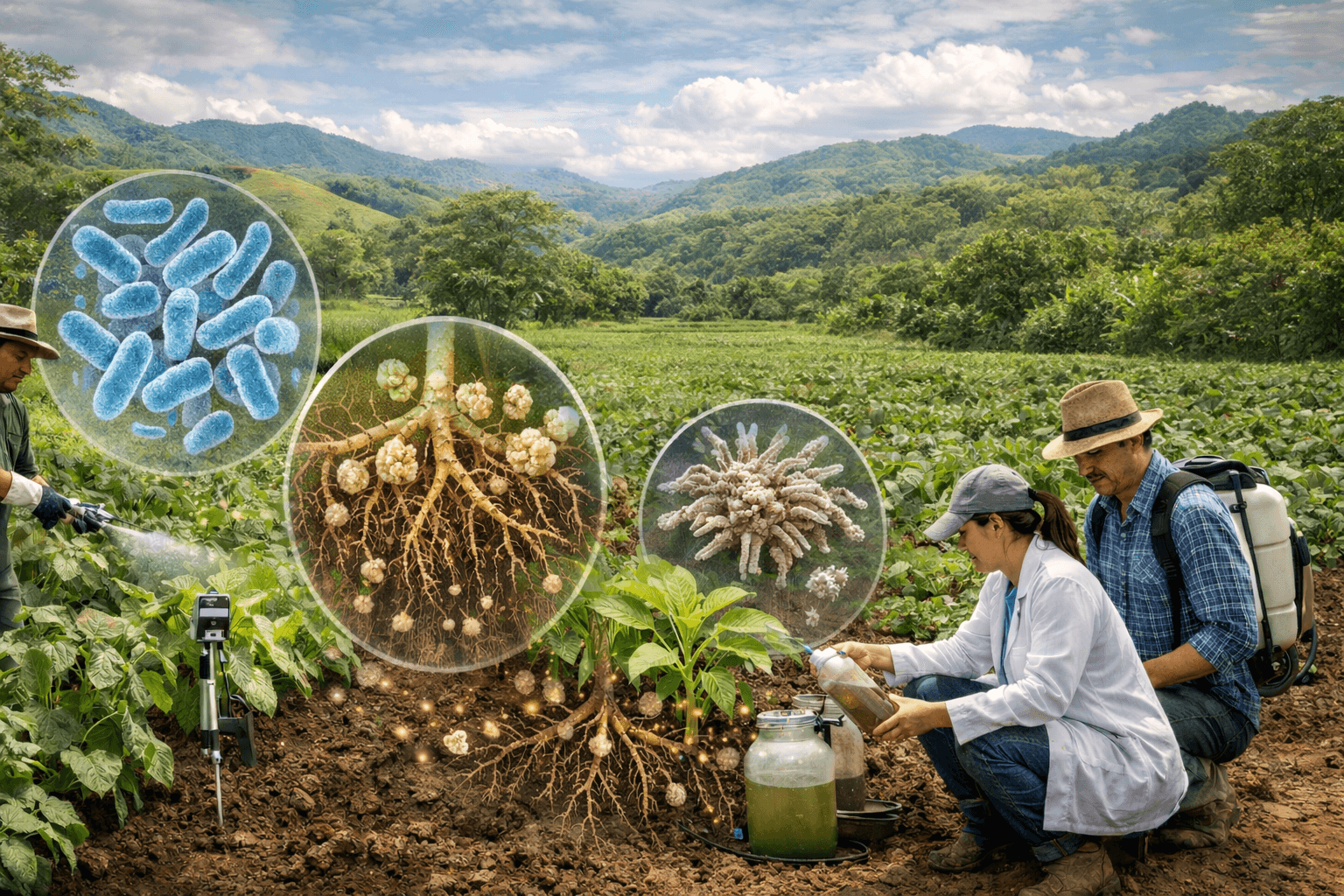
Biologicals are products derived from living organisms, microorganisms, macroorganisms, botanical extracts and their derivatives, applied in agricultural production. The project works with three broad groups: biofertilizers based on nitrogen-fixing and phosphorus-solubilizing bacteria; biopesticides derived from entomopathogenic fungi such as Beauveria and Metarhizium and from the bacterium Bacillus thuringiensis; and botanical extracts for weed control, alongside agents such as Trichoderma for fungal diseases. Each option advances through successive validation stages, from the laboratory to controlled greenhouse conditions and, finally, field trials, according to its level of technological maturity. The goal is to offer efficient, affordable solutions that improve crop nutrition and health, reduce dependence on agrochemicals and can be adopted by small and medium-scale producers.
"Biologicals put sustainable, affordable technologies within reach of small and medium-scale producers, helping them produce more while protecting the environment and health."— Project team
 Integrated Pest ManagementAppliedTechnological
The project aims to increase the availability of validated bio-inputs for the region. Expected results include cutting chemical fertilizer use by at least 25% through nitrogen-fixing and phosphorus-solubilizing microorganisms, with gains above 30% in phosphorus availability and above 20% in biological nitrogen fixation. For pest control, it anticipates a 50 to 70% reduction in the incidence of Spodoptera frugiperda in maize and Anthonomus eugenii in sweet pepper, and up to 70% lower severity of diseases such as Fusarium and Cercospora through Trichoderma. Botanical extracts seek to reduce weed density by up to 60%. The project also plans to integrate at least five bio-inputs per crop and to achieve effective pest and disease control in at least 70% of monitored cases.







Sede Central

Costa Rica
Honduras

Panamá

Venezuela

The Tangible Impact of Science and Technology in the Field

 Impact
 Initiatives
 Dashboard
 Alliances
 Impact
 Initiatives
 Dashboard
 Alliances




.jpg&w=750&q=75)