



 November 26, 2026
 7.00 PM
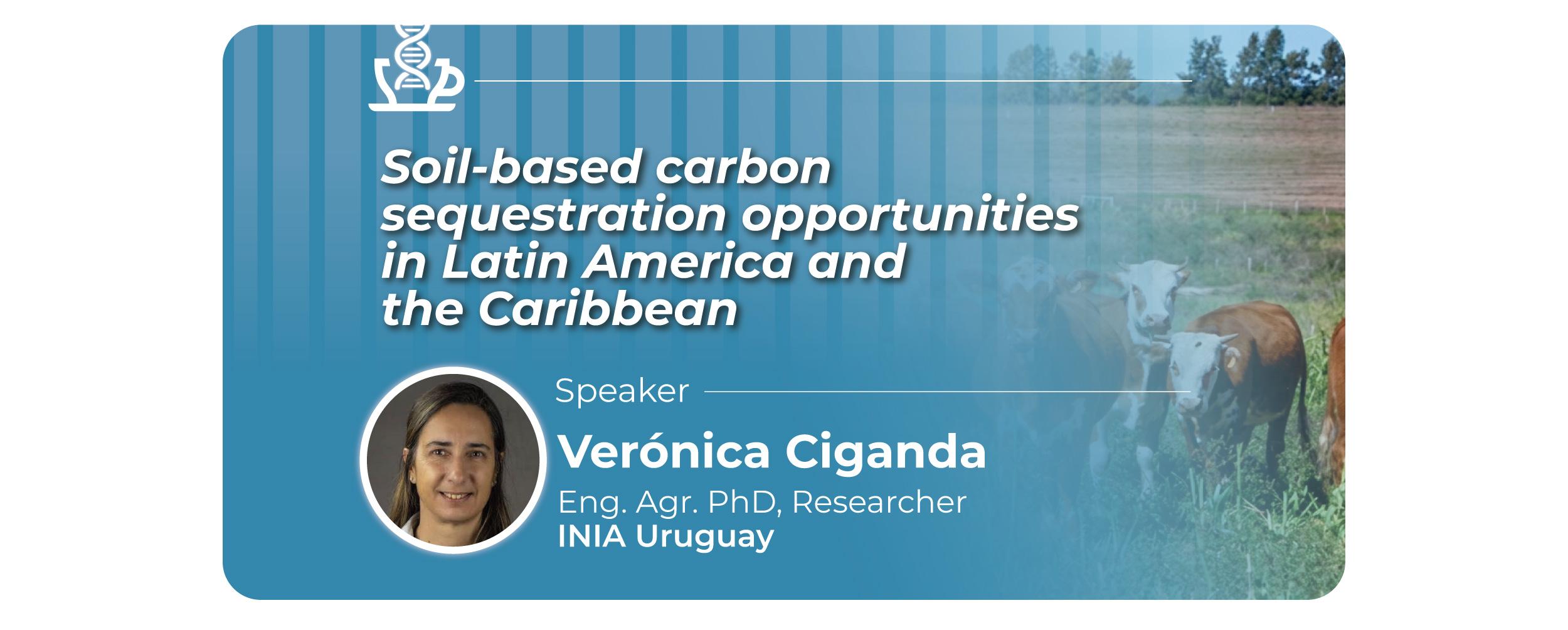
Agricultural soils have great potential to store carbon. To make the most of it, countries need reliable local data and tools to measure and monitor soil carbon over time. In this Science Café, Dr. Verónica Ciganda will present the main results and lessons learned from the project “Soil-based carbon sequestration opportunities in Latin America and the Caribbean.” The project was funded by the Government of New Zealand as part of its contribution to the Global Research Alliance on Agricultural Greenhouse Gases (GRA). It was carried out by INIA Uruguay, INTA Costa Rica, AGROSAVIA Colombia, INIA Chile and INTA Argentina. Dr. Ciganda will share how this regional initiative made soil organic carbon easier and less costly to estimate and strengthened technical capacity in the participating countries. She will also discuss management strategies that can help make production systems more sustainable and more resilient to climate variability.
Verónica Ciganda holds a degree in Agricultural Engineering from the Universidad de la República (Uruguay) and earned her M.Sc. and Ph.D. at the University of Nebraska-Lincoln (United States). She is a Principal Researcher in the Natural Resources, Production and Environment Area of Uruguay’s National Agricultural Research Institute (INIA). From 2018 to 2021 she directed INIA’s Production and Environmental Sustainability Program, and from 2022 to 2024 she coordinated the institute’s Natural Resources, Production and Environment Area. She has led and taken part in national and international projects on greenhouse gas emissions from livestock and crop production systems, the interaction between agricultural production and water quality, life cycle assessment of pasture-based cattle production, and the sustainability of native forests affected by livestock production. She currently leads the FONTAGRO project on soil-based carbon sequestration in Latin America and the Caribbean.
Date and time: Thursday, November 26, 2026, 2:00 p.m. (Washington, D.C. time)
Free registration here.
Learn more about the project here.
 Impact
 Initiatives
 Dashboard
 Partnerships

 Impact
 Initiatives
 Dashboard
 Partnerships